Thursday, January 17, 2008

Gender and the Truth And Reconciliation Commission


Word for the Day
When the love of power is replaced by the power of love, the world will know peace


Introduction
While many individuals are familiar with South Africa's Truth and Reconciliation Commission (TRC), fewer are familiar with what it means to apply a gender analysis to peacebuilding efforts. Thus, Beth Goldblatt and Shiela Meintjes have made an important contribution to peacebuilding efforts in general and more specifically to the TRC process as a result of their Report titled, Gender and the Truth and Reconciliation Commission. While both women are affiliated with the University of Witwatersrand in the Republic of South Africa, Goldblatt is with the Department of Political Studies and Meintjes is associated with the Gender Research Project/Center for Applied Legal Studies. Oftentimes peacebuilding and development efforts either fail to include women in its infrastructure and capacity building or simply exclude women's perspective and assume that war and conflict impact women and men in identical ways. While in theory we know this is not the case, we continue to witness evidence of such exclusions that essentially render women invisible. This is not a new phenomenon. During the post colonial period beginning with Ghana's independence in 1957, as former colonies of empires gained their independence development planners and efforts oftentimes overlooked women.

In this instance, I am using development to mean the process that a nation undergoes that promotes a quality of life for its citizens politically, socially, and economically. During the postcolonial period when nations were in a period of development and reconstruction, it was much clearer what the needs of nations were. Typically such countries economies had been manipulated and monopolized to provide the needs of the empires and to compromise the internal needs of its citizens. The extraction of natural resources and the failure to invest in either the country or the people resulted in resource rich nations like Nigeria, Ghana and Kenya that were nevertheless impoverished. Once the development processes began developers often ignored women's roles in agriculture and dealt with the males thus further marginalizing women in countries such as Africa, Asia and Latin Americ where women have had to fight for their place at the table of opportunity. Thus gender is an integral component of social analysis because these differences as a result of patriarchy have accorded women subordinate identities. The marginalization of women has often been reinforced by violence.

Goldblatt and Meintjes did not leave matters to chance that the TRC would in fact possess a gender sensitivity. Instead they prepared an extensive report that began with the history of women in South Africa. They chronicled the historical development of apartheid and its attempts to assume control of the country's development while maintaining totally separate systems between the races. The report provides an extraordinary window into the experiences of women that were impacted by apartheids efforts to sustain its evil system while they along with men and children fought back by every means necessary, including armed struggle and peaceful activities.

As Goldblatt and Meintjes emphasize, it is important to understand that men and women were both subjected to terror and torture during apartheid. Both men and women were in the words of the authors, "brutally beaten; slammed against floors and walls; flung around on beams; deprived of sleep; forced to stand or sit on imaginary chairs for hours; tear gassed; held in solitary confinement for months on end and forced to endure days of endless inerrogation and even killed." But the nature of these experiences, even the sexual aspects, were experienced differently. In some ways it can be compared to the reality that women are discriminated against but not all women are discriminated against in the same way. Thus, women during apartheid were often singled out as women and certain aspects of being female became points of focus. For instance, assaults on pregnant women, which led to miscarriage, body searches, vaginal examinations, were all assaults on the sexuality and sexual identity of women. The intention of Goldblatt and Meintjes is to show that gender was a key aspect in the use of power and control and the subsequent relations reflected those power dynamics.

Were the authors successful in accomplishing their goals? That is difficult to determine at this stage of my research efforts. If nothing more, the report was an attempt to convey important information and education to the TRC. Perhaps others have benefitted from its content. I am certainly indebted to them and plan to follow up to determine whether in their opinion the report made a difference.

You can find the official website of the TRC at: http://www.doj.gov.za.trc/
and the report, Gender and the TRC is located at: http://www.doj.gov.za/trc.trc_framset.htm

Blessings! Rev.Dr. Qiyamah A. Rahman

Friday, January 11, 2008

Courting the Muse in Costa Rica


I have arrived in Costa Rica and settled into my daughter's tiny apartment in San Jose. The apartment is quite charming.

My purpose for coming to Costa Rica is to write with the intent of publication, spiritual rejuvenation and to visit with my daughter so that the two of us can work on spiritual rejuvenation.

In addition, a long time friend, Stephanie Berry, also my daughters godmother, will be joining us. We will all collaborate on a joint writing project that we are very excited about although we have no idea what it is going to look like. But that is the beauty of it and the mystery of it. Being in a new place pushes the envelope. We don't have any expectations about how this will look or should look! Even as I do quite ordinary things I am mindful that I am in a place where people speak a different language from me, have different cultural customs and beliefs and that I am the "other"; the "outsider." How will that impact my writing and what I bring to my writing? I know it has already provided me time that I do not manage to have in the states. I am attempting to access parts of myself not so easily available in a familiar setting where I take so much for granted such as who am I? why am I? etc.

I have already done an amazing amount of writing. I finished one piece and have now set it aside. I isolate myself daily and write and read during the day. At lunch time my daughter breaks for lunch some days and we visit the local vegetarian restaurant. Today I will have the entire day to myself.

Today will be the first day that I will venture out on my own. I always have "visitor's anxiety" whenever I travel abroad. I believe it is a combination of feeling like "other" magnified by my lack of language skills and my extreme self consciousness. I will take my daughters Spanish dictionary with me when I go out.

Journey to Costa Rica
I had the most amazing experience coming over. My flight in Chicago was delayed and as a result I missed my connection in Dallas. I had to stay over in Dallas and fly out the next morning. American Airlines upgraded my seat to business/1st class along with another passenger, Chris Vaughan. It turns out that he lives in Madison, Wisconsin and attended a Unitarian Universalist congregation there where he really enjoyed the minister. He also is an adjunct professor at the University of Wisconsin and teaches in the Dept of Wildlife Ecology and the College of Agricaultural & Life Science. We talked extensively about ecology, Fair Trade, chocolate, his farm, and the life he has made for himself over the years living and working between the States and Costa Rica. He has created a lifestyle that reflects his passion and commitment to preserving the environment and living simply. I shared some of the things that UUs are doing to conserve energy and the environment. I wish him the best and even went on line to find some UU websites that reflect some of our environmental actions and involvements and sent them to him.

Well, time is awasting and I have lots of reading to do in preparation for a class that I will be serving as Teaching Assistant in titled, The Art and Ethics of Strategic Peacebuilding. Sharon D. Welch is the Professor. That was another surprise, Chris' daughter just graduated from the UN Peace University that my daughter had suggested that I might want to take a class at. Chris also teaches conflict resolution/management and promised to send me his syllabi.

Whenever I have encounters that feel almost "magical" I know that it is the energy in the universe responding to my direction for certain types of people and resources to show up in my life. Learning to manipulate and direct energy is a powerful tool in self awareness and development. It can be and is a potent resource in healing and transforming ourselves and the planet.

Perhaps, I will talk more about this in a future posting.
Well, back to the writing and reading.
Blessings!
Rev. Dr. Qiyamah A. Rahman

Tuesday, January 1, 2008

The Moynihan Report


(Family Ties That Bind - picture taken by Qiyamah A. Rahman, 2006)

In the process of doing some research I came upon the Moynihan Report. It brought up a lot of memories and I wanted to see how I would react to it fifty three years later. My first shock was that I remembered so vividly the report and the nature of the controversy. Secondly, had it really been fifty three years? Daniel Moynihan, then Assistant Secretary of Labor died back in 2000 so I cannot engage him in any direct dialogue in retrospect.

For some of you too young to remember, the Moynihan Report on the "Negro Family" in 1965 was almost as controversial as Don Imus' recent derogatory statement about black women. The difference was that Daniel Patrick Moynihan was a top ranking official working, Assistant Secretary of Labor. And like Imus, he probably did not have a clue that he was about to set off one of the biggest controversies in the Black community and elicit the rage of Black folks! My lasting perception of the controversy was that Moynihan, in an effort to explain the problems of the Black family, Negro at the time, blamed it on Black women who the Report depicted as demasculizing the Black male.

Now, for the sake of accuracy I am going to reread the Report and determine if that is still the take-away-message or if in the anger and rage of the times that I got it all wrong, along with a lot of other angry black folks!

Meanwhile, you can begin to read the introduction to the reportbelow or go the website and read the report in its entirety at: http://en.wikipedia.org/wiki/Moynihan_Report.

Meanwhile, here is someone else's summation:

The Negro Family: The Case For National Action, also known as the Moynihan Report, named after U.S. Senator Daniel Patrick Moynihan, the author of the controversial report, which was released in 1965. It hypothesized that the destruction of the Black nuclear-family structure would hinder further progress towards economic, and thus political, equality.

An excerpt from the book Representing: hip hop culture and the production of black cinema by S. Craig Watkins explains

The report concluded that the structure of family life in the black community constituted a 'tangle of pathology...capable of perpetuating itself without assistance from the white world,' and that 'at the heart of the deterioration of the fabric of Negro society is the deterioration of the Negro family. It is the fundamental source of the weakness of the Negro community at the present time.' Further, the report argued that the matriarchal structure of black culture weakened the ability of black men to function as authority figures. This particular notion of black familial life has become a widespread, if not dominant, paradigm for comprehending the social and economic disintegration of late twentieth-century black urban life. (pp.218-219)


Happy Reading and Happy New Year!
Rev. Dr. Qiyamah A. Rahman


The Negro Family:
The Case For National Action

Office of Policy Planning and Research
United States Department of Labor

March 1965

--------------------------------------------------------------------------------

Two hundred years ago, in 1765, nine assembled colonies first joined together to demand freedom from arbitrary power.

For the first century we struggled to hold together the first continental union of democracy in the history of man. One hundred years ago, in 1865, following a terrible test of blood and fire, the compact of union was finally sealed.

For a second century we labored to establish a unity of purpose and interest among the many groups which make up the American community.

That struggle has often brought pain and violence. It is not yet over.

State of the Union Message of President Lyndon B. Johnson,
January 4, 1965.


--------------------------------------------------------------------------------

The United States is approaching a new crisis in race relations.

In the decade that began with the school desegregation decision of the Supreme Court, and ended with the passage of the Civil Rights Act of 1964, the demand of Negro Americans for full recognition of their civil rights was finally met.

The effort, no matter how savage and brutal, of some State and local governments to thwart the exercise of those rights is doomed. The nation will not put up with it — least of all the Negroes. The present moment will pass. In the meantime, a new period is beginning.

In this new period the expectations of the Negro Americans will go beyond civil rights. Being Americans, they will now expect that in the near future equal opportunities for them as a group will produce roughly equal results, as compared with other groups. This is not going to happen. Nor will it happen for generations to come unless a new and special effort is made.

There are two reasons. First, the racist virus in the American blood stream still afflicts us: Negroes will encounter serious personal prejudice for at least another generation. Second, three centuries of sometimes unimaginable mistreatment have taken their toll on the Negro people. The harsh fact is that as a group, at the present time, in terms of ability to win out in the competitions of American life, they are not equal to most of those groups with which they will be competing. Individually, Negro Americans reach the highest peaks of achievement. But collectively, in the spectrum of American ethnic and religious and regional groups, where some get plenty and some get none, where some send eighty percent of their children to college and others pull them out of school at the 8th grade, Negroes are among the weakest.

The most difficult fact for white Americans to understand is that in these terms the circumstances of the Negro American community in recent years has probably been getting worse, not better.

Indices of dollars of income, standards of living, and years of education deceive. The gap between the Negro and most other groups in American society is widening.

The fundamental problem, in which this is most clearly the case, is that of family structure. The evidence — not final, but powerfully persuasive — is that the Negro family in the urban ghettos is crumbling. A middle class group has managed to save itself, but for vast numbers of the unskilled, poorly educated city working class the fabric of conventional social relationships has all but disintegrated. There are indications that the situation may have been arrested in the past few years, but the general post war trend is unmistakable. So long as this situation persists, the cycle of poverty and disadvantage will continue to repeat itself.

The thesis of this paper is that these events, in combination, confront the nation with a new kind of problem. Measures that have worked in the past, or would work for most groups in the present, will not work here. A national effort is required that will give a unity of purpose to the many activities of the Federal government in this area, directed to a new kind of national goal: the establishment of a stable Negro family structure.

This would be a new departure for Federal policy. And a difficult one. But it almost certainly offers the only possibility of resolving in our time what is, after all, the nation's oldest, and most intransigent, and now its most dangerous social problem. What Gunnar Myrdal said in An American Dilemma remains true today: "America is free to chose whether the Negro shall remain her liability or become her opportunity."

Table of Contents

Chapter I. The Negro American Revolution.

Chapter II. The Negro American Family.

Chapter III. The Roots of the Problem.

Chapter IV. The Tangle of Pathology.

Chapter V. The Case for National Action.

Footnote References.

Friday, December 28, 2007

Transformations


One never knows the impact that a small gesture can make on anothers life. I was googling the name of a long time friend that I had not seen in many years, Nubia Kai Salaam and came across the following account by Brother Ahmed Abdul Rahman. Evidently, he was in prison and Nubia visited him to conduct an interview. She later sent him a Qu'ran, prayer rug and some books on Sufism.
May the deeds that we do speak for us!

In this essay, Brother Ahmed reflects on his spiritual journey towards Islam as well as the era when the Panther Party was viewed as a viable vehicle to organize the Black community and to educate it about some of the contradictions of growing up Black in Amerika. It seems that somehow that made the Panther Party a threat and the rest is history. However, it is a history that our children will forget if we do not remind them. Brother Ahmed was one of many brothers that ended up as political prisoners in what has become a prison industrial complex that warehouses far too many people of color.
May the truths that we learn guide our steps along this tedious journey called life!Peace and Blessings! Rev. Dr. Qiyamah A. Rahman

TRANSFORMATIONS

Compiled By: Hajj Mustafa Ali

Story by Ahmed Abdul Rahman
On the south side of Chicago, during my teens in the turbulent sixties, powerful philosophies competed for the loyalties of young black men and women. I was familiar with the un-Islamic doctrines of Elijah Muhammad’s Nation of Islam: white people are a race of devils. They had been invented 77 trillion years ago by a diabolical black scientist named Yaqub. Yaqub began the process of inventing the white devil race by grafting two albinos from the original race of black people. The black man is the Original Man, a veritable god, who once ruled the world and is destined to rule again. Allah came in the person of an Arabian silk merchant, Master Fard Muhammad, to Detroit in 1930. Allah came to deliver the so-called Negro from 400 years of physical and mental bondage in the wilderness of North America.

Upon this basic mythology Elijah Muhammad built a super structure of discipline. He taught his followers to abstain from all intoxicants, tobacco, fornication and adultery, pork and all non-nutritious foods. Mr. Muhammad encouraged hard work, higher education, thrift and strong family values.

I found Elijah Muhammad’s mythology easier to accept than the teachings of Christianity that I had heard all of my life. As the era of black pride and black awareness brought me more knowledge of my people’s history, I found the philosophy of the Nation of Islam even more acceptable. Knowing that the blond haired, blue eyed and Caucasian, made this God, Jesus, even more unacceptable to me.

I left home when I was seventeen and got a job at Bagcraft International. My job was running a machine that put wax on giant roles of paper that would be sliced and folded by another machine into potato chip bags. At Bagcraft I met two students from Lagos, Nigeria – Onyxx Olajinka and Shakiru Kensington. They were the first indigenous Africans and the first (Sunni) Muslims I ever met. We quickly became friends. I communicated best with Shakiru. He told me a lot about African culture and politics. I asked him about African Islam and told him that I was inclined toward the teachings of Elijah Muhammad.

I could see Shakiru’s reluctance to go any deeper. Hindsight tells me that he probably knew that violent conflicts had broken out between Sunni Muslims and members of the Nation of Islam when the Sunnis had tried to inform the latter that Elijah Muhammad’s version of Islam was un-Islamic. Not knowing how dedicated I was to Elijah Muhammad, or how I might respond, Shakiru probably thought silence was the wisest course.

But, unbeknownst to himself, Shakiru would play a key part in my not ever joining the Nation of Islam. I graduated from high school and sought and found a better job. I told Shakiru that I would be leaving Bagcraft. On my last working day Shakiru gave me a green, brown and orange knee-length shirt with matching pants that he had brought with him from Lagos. The colorful, soft cotton shirt and pants from Africa were to me a treasure.

I left Bagcraft. As the months progressed I became more inclined to join the Nation of Islam. I had brought a copy of the Qur’an. My study sessions in the divine revelation however were spent trying to find Elijah Muhammad’s white devils, and confirmation of Elijah Muhammad’s being a Messenger, and of the black man’s status of God. Consequently, since, as the Qur’an says, ‘no person can touch the knowledge in the Qur’an who does not come to it with pure intentions', each time I picked it up I put it down more befuddled. I did understand the books that I read that either Elijah Muhammad or his followers wrote. I concluded that the Nation of Islam was the best place for me. On a Sunday afternoon I put on my treasured African shirt and walked the six blocks to the Muslim’s Temple #2. This day I would officially join and declare my faith in Allah, as having come in the person of Master Fard Muhammad, and my loyalty to Elijah Muhammad as his last Messenger.

As I approached the front door of the Muslim temple, one of the guards stopped me. He looked down at my shirt disapprovingly and shook his head. “No, sir”, he said. “Last week the captain made a rule: without proper attire nobody can be admitted.” By proper attire he meant a white shirt and tie.

I turned around and walked home. My main stalling point, keeping me from joining the Nation of Islam, was Elijah Muhammad’s downgrading of the importance of African culture. His followers did not wear Afros, nor did they participate in the African cultural awakening then sweeping black America. The Muslim guard had struck me precisely on this sore point. In so doing, he enlarged my cultural objections to joining the Nation of Islam to the extent that I assessed his refusal to admit me because of my shirt as a sign that I did not belong in the Nation of Islam.

The Black Panther party was then arising as a strong influence among young people in Chicago. I was impressed by their stalwart stance for black community control of the educational, economic, and criminal justice institutions, which affected our lives. During the latter 1960’s, statistics revealed that the mainly white Chicago Police Department killed more citizens per capita than did any police department in the United States. Most of the dead were black. The Black Panther Party alone stood up and publicly stated that black people had a right to armed self-defense from racist attacks.

Some of my friends and former schoolmates were Black Panther Party members. They encouraged me to study the ideologies, which they had discovered, and I did. Since my early childhood I always felt a persistent yearning for some form of supreme knowledge and wisdom, which would answer for me the important questions of human existence. Marx, Lenin and Mao opened up another world of ideas to me. This trinity of revolutionaries explained to me social and economic phenomena, about which I had been long curious, but about which I could nowhere else find answers.

Since my Christian upbringing had taught me that a white man is God, and Elijah Muhammad had taught that the black man is God, I had no difficulty accepting the Marxist contention that the masses is God. The laboring masses could destroy and create whole social economic systems according to their collective will. The slogan of the Black Panther Party “serve the people” touched a part of my psyche that was self-abnegating and which sought a feeling of fulfillment by helping others. I concluded that life would never offer me a higher calling than serving my people, and I joined the Black Panther Party.

In 1969 and 1970, the Black Panther Party denounced the spreading drug plague as a holocaust that was just beginning and we felt justified in using extreme measures to prevent this holocaust. We felt especially compelled to move physically against dope houses because police forces in America’s major cities were either turning a blind eye to this burgeoning problem, or, as subsequent investigations exposed, were themselves directly involved in drug trafficking.

The Black Panther Party’s uncompromising stands caused the party’s ranks to swell with idealistic young people. As Kenneth O’Reilly noted in his book, ‘Racial Matters: The FBI’s File on Black America' 1960-1972:

“The Black Panthers attracted the nation’s attention, so J Edgar Hoover decided that they had to be destroyed…

Hoover’s pursuit of the Black Panther Party was unique only in its total disregard for human rights and life itself.” *

(*Kenneth O’Reilly, “Racial Matters: The FBI’s Secret File on Black America” – {New York: The Free Press, 1989} p. 294.)

As a result of this FBI terror campaign, I was targeted, along with most other leading party members. Over twenty-five Panthers were killed in police search and destroy operations. In one of our operations against a supposed dope house in which I participated, one of my fellow Panthers accidentally shot and killed a man. Even though I was not present in the room when the shooting took place and even though my fellow Panther pleaded guilty to committing the shooting, on September 23, 1971 a jury convicted me of first degree murder in Detroit’s Recorders Court. That same day a judge sentenced me to spend the rest of my natural life in prison. I had just had my twentieth birthday.

Subsequently, discovered information revealed that I and my three co-defendants had been set up by an FBI plant inside the Black Panther Party. The house we raided was not a real dope house. The ranking party member who sent us to this house gave our names to the police. Nevertheless, describing the techniques of government agents-provocateur is not my purpose here. Allah is the best arranger of affairs. He knows what is before us and behind us.

What was before me then was prison. In prison I and my new Marxist and Black Nationalist comrades continued our studies of the revolutionary classics. I taught classes on dialectical materialism in which I ‘proved’ the non-existence of God.

While outwardly I was strong, and exercised a leading role in the prisoner’s movement, inwardly I began to feel the full strain of my position as a man in his early twenties in prison with a natural life sentence. My son was born two weeks after my sentencing. During the time before I joined the Black Panther Party, when I was trying to understand the Qur’an, I had read in the commentaries a definition of the word ‘Rahman’. Like a beautiful note in a musical composition, this one word ‘Rahman’ had touched my heart. I could not remember a single word from the English translation of the Qur’an that I had read. But this word ‘Rahman’ stuck in my mind and heart .I told my son’s mother to name him Rahman and she complied. But her hardship in raising this baby alone, while she also had to withstand harassment by the FBI, distressed me greatly.

Moreover, the agony that my imprisonment had brought to my parents caused me many moments of private anguish. Guards, who saw me as a threat to their cherished American white power system, never tired of putting me under extra pressure. Hatred and bitterness built up in my heart and mind. Living in a continuous state of anger, I began to alienate even persons who were trying to help me get out of prison.

The gifted black psychiatrist, Frantz Fanon, taught that by pouring our energy into the struggle against the forces, which oppress us, we can neutralize the negative psychological and emotional affects of oppression. Around mid 1974, my personal stresses became so severe that this technique stopped working for me. But I had nowhere to turn for help. I did not believe in God. I could not go to any prison sociologist or psychiatrist seeking relief from my agonies. These employees of the state would have rejoiced if I had shown any sign of weakening.

Then a new prisoner moved into a cell near to me. We challenged each other to a chess shoot out and in the heat of the competition became friends. In a chess game a player reveals many of his characteristics as a person. After several games my new friend suggested that I read a book, which belonged to him. He said the book, “Christian Yoga” would show me how to relieve my tension and deal better with stress.

A French Catholic priest was the author of “Christian Yoga”. His book contained chapters on yogic stretching and bending exercises, breathing techniques, meditation, and sublimation of sexual energy. I read the book and immediately regarded yoga as a serendipitous discovery. I drastically reduced the meat I consumed. I started to gradually break my body into the bending, breathing and stretching exercises. I began trying to practice the mind clearing meditation exercises. I ignored the author’s words about communing with God. Still a confirmed atheist, my interest resided solely in yoga’s physical and mental benefits. Within weeks I could relax my entire body. I could sleep more peacefully, and I could concentrate my mind more one-pointedly on my two principal goals at that time: mastering enough legal knowledge to get myself out of prison, and getting the bachelor’s degree in the college program that Detroit’s Wayne State University established in Jackson Prison.

The benefits of yoga caused me to seek other books on Eastern systems of self-development. A professor in the Wayne State program, Dr Gloria House shared with me some of her books on Zen Buddhism. She also encouraged me to modify my hard line atheistic Marxism. She shared with me other ideas and books, which gradually began to broaden my world outlook and to humanize my understandings of the clash of social classes and the struggle of nations for liberation.

Through Zen meditation I experienced my most intense awareness of a spiritual dimension of life. I perceived this dimension as a oneness of all creation that is not separate from myself as the perceiver. At deeper levels of meditation, when I peered into the subtle essence of reality, I perceived a living, powerful, mellow energy, which vibrated from within all of creation. But this force to me was impersonal and metaphysical, not divine.

At this time I acquired from the prison library the book “How to Know God, The Yoga Aphorisms of Patanjali.” A deeper knowledge of yoga was my main interest in this book, but the title presented me with a challenge. I saw Patanjali’s 2000-year-old teachings a dare: You don’t believe God exists, hunh? Patanjali challenged. I say that if you follow these instructions you will come to know God. Now step forward if you have the courage. Certain that God did not exist and that in the end I would prove Patanjali wrong, I answered the challenge.

Patenjali’s system basically involved, 1) strict asceticism to withdraw the senses from any desires for physical pleasures. 2) Meditation to withdraw the mind from attachment to any sense objects. 3) Continuously controlling the thought waves and permitting only waves of love to arise in the heart and mind. By this means the yogi strips back the layers of the physical to unveil deeper levels of the mind-soul. The yogi replaces the enjoyment of physical pleasure with the experience of an indescribably blissful spiritual pleasure and he supplants his individual love for finite creatures by communing with God’s infinite cosmic Love.

I pursued Patanjali’s system and, to my amazement, I ‘saw’ God with the eye of my heart. I perceived Allah through His divine attribute ‘Al Wadood’, The Loving. In prison’s grim ugliness, a man must struggle to maintain the humanity to love anybody or anything. But after fasting and meditating and closely following Patanjali’s instructions my heart swelled with a blissful, transcendent, divine love that was the most intense and awe-inspiring experience of my life.

In 1848, Karl Marx wrote, “Religion is the only illusory sun which evolves around man as long as he does not revolve around himself.“ My heart’s opening to divine knowledge instantly informed me that atheism is a failure of perceptive awareness. Atheists are like blind persons trying to convince persons who see the stars that those stars do not exist because in their blindness they do not see them. Indeed, as Allah says in the Qur’an “verily the blind and the seeing are not alike.”

Climbing the ladder of yogic advancement I gained a tremendous sense of self -mastery. Indeed this self-mastery was the purpose of yoga and hence becoming my all-consuming purpose. I gained magical powers. I could hear a person’s words in my mind moments before he spoke them. I could decrease and increase my pulse rate at will. I even convinced the prison doctor to place me on a special low sodium diet by raising my blood pressure at the moment he gave me the blood pressure test.

But I did not realize that as I opened my being and gained a super sensitivity to the positive cosmic vibrations, I simultaneously opened myself to all of the extraordinarily negative vibrations, which abound in prison. The yogic powers placed me at such an advantage over the men around me that I began to regard myself as not only a master of myself, mastered the profane, and mastered the divine.

But I turned into Sisyphus. I would roll my spiritual boulder back up to the peak, and then some negative event would cause me to lose my grip and the boulder roll over me all the way back down the mountain. Increasingly, I came to understand that my yogic relationship to the ‘It’ would remain on my spiritual peak only if I moved away from any possible negative eruptions in my everyday life. I could sustain and stabilize myself as a master only if I moved into a cave in the Himalayas. Or I would have to live as a monk in an ashram or a monastery. Even if these choices had been possible, they still would not have been desirable. For I could not participate in any spiritual path which forced me to separate myself from the struggle of my people for their collective betterment.

I began to look more closely at the men in prison whom I knew pursued spiritual paths, participated in worldly affairs, and yet appeared to have stabilized their relationship with God. Those men were either Bahais, Christians or members of the Nation of Islam.

I quickly discovered that in Jackson Prison during the middle seventies, Bahai meetings were a surreptitious front for homosexual liaisons. This prevented me from attending any of their meetings. I did, however, read one of their founder’s books.

I moved on to the study of Christianity. In a Zen story a novice swordsman visits a master seeking knowledge. The master asks him if he is thirsty. The novice answers affirmatively. The master then begins to pour water from a pitcher into a cup. He pours until the cup is full and keeps on pouring so that water is spilling onto the table. The startled novice asks the master why he is doing this. The master informs him that his mind is like the cup when it is full of water. No more water can enter because of the fullness. He tells the novice that the only way he can absorb the wisdom he has to teach is if he first empties his mind of all of his preconceived notions.

Before opening the Bible I emptied my mind of all prejudices against Christianity, and of all preconceived notions about Jesus. To my amazement I found in Jesus a teacher of the most profound and spiritually sublime wisdom. But I was concerned by the wide variance between the saintliness that Jesus’ life represented, and the inability of his followers to translate the perfection of his lofty and other – worldly teachings to the everyday realities of their lives. Jesus reminded me of the Hindu saint Shankara who taught an almost parallel system of self-denial. Jesus told his followers to give away their worldly goods to the poor and to follow him. This is precisely the way of life of the mendicant Hindu monks.

Then there were the imprisoned members of the Nation of Islam. I did not give their “Islam” any serious consideration. After years of studying pseudo-scientific atheist doctrines, I did not think that Elijah Muhammad’s pseudo-scientific doctrines – about white devils being grafted 7 trillion years ago by a black scientist – deserved any reconsideration. Then in February 1975, Elijah Muhammad died.

I began to buy the “Muhammad Speaks”, which became the “Bilalian News”, from the Muslims who sold the paper on the prison yard. I watched the ascension to leadership of Elijah Muhammad’s son, Wallace D Muhammad. I noticed Wallace’s gradual yet distinct movement away from his father’s doctrines. I noticed, too, that in Jackson Prison the Nation of Islam members began to walk around the yard in small groups practicing Arabic prayers. They ceased talking about Yaqub, white devils, and Allah coming in the person of Master Fard. They began talking about the Arabian Prophet Muhammad ibn Abdullah, and his Ethiopian companion, Bilal, who was the first man to call Muslims for prayer. And they began to speak of Allah as not a man, but as Unseen, Gracious, Ever-Living. Elijah Muhammad had said that whenever the Qur’an mentioned the hereafter, it meant a Muslim’s life after he left the death of unbelief for the life of Islam. No life exists after physical death, according to Elijah Muhammad. But now I heard Muslims talking about life in the Hereafter and living their present lives in such a way that they would secure for themselves blessed places in the Afterlife.

Right at this time the Muslims in Jackson prison decided that they would put out a small newspaper called “Al Haqq”. Their former minister, Derrick Abdur Rahim Ali, who now carried the title Imam, asked me to work on the paper. I agreed to help out. Working with the Muslims up close, I gained a deeper appreciation of their metamorphosis. I had worked with members of the Nation of Islam for years so that I could detect the difference.

Before, under the teachings of Elijah Muhammad the Muslims were known for their discipline, loyalty, courage, and for always holding true to their words. Now that they were becoming Sunni Muslims, they retained their all of their old positive qualities, but now I sensed an inner peace and harmony about them that I had not detected before.

At precisely this time the host of a black arts and perspectives programmed on the Wayne State University FM station came to Jackson Prison to interview me. Her name was Nubia Kai Salaam. She had been an orthodox Muslim for over five years. I read some of my poems on her program and discussed general problems facing the black community. A couple of weeks later I unexpectedly received in the mail a Holy Qur’an, a prayer rug, and two books on Sufism. Sister Nubia had sent them.

This time when I opened the Qur’an I was not searching for any justifications for any prejudices against any race or class. I just opened my heart to whatever knowledge the book had to convey. I remember this verse striking a resonant chord in my heart: ‘Allah created the Jinn and the men but to serve Him’. I understood at once that one of the reasons for my spiritual ups and downs was my acting upon an incorrect understanding of my proper relationship to the Creator. I am not the Master but Allah is Ar Rabb (the Lord) and Al Malik (the King). I had violated my proper relationship with Allah when I had sought to make Him serve me, when He, in reality, is Master and He created me solely to serve Him.

I understood further from the Qur’an that Allah is not an impersonal ‘It’. Allah is always an intensely personal ‘Thou’. Allah is the Inner and the Outer. He exists beyond my manipulation. No matter how much I meditated, fasted, deep breathed, stretched, Allah does not change. Moreover my proper relationship with Allah, according to the Qur’an, involves a covenant. In exchange for my submission to Allah’s will and my striving with my life and property in His cause, He promised me the blessings of this world and of the Hereafter. And Allah is the best Knower about these blessings. My purpose was to submit to His will, and to accept His sustenance, not to seek supernatural powers and to predicate my spiritual practices upon seeking any particular kind of blessing.

I recall how momentous I felt on these initial occasions when I reached into the holy pages and came out with these gems. I would have to break with some of my former associates who could accept my yogic relationship with an impersonal source of energy, but who regarded as a serious weakening any declaration of faith in ‘Al Ahad’ (The One). I knew that then. But if I had to displease men to please Allah, then men would just have to suffer displeasure.

One evening after studying the Qur’an, I spread on the cell floor the green and black prayer rug that sister Nubia had also sent to me. I prostrated into sajdah, as I had seen Muslims do. I did not then know the words to any Islamic prayers, so I kept on repeating a phrase I heard the Muslims say, whose meaning I knew – “Allah Akbar” (God is Great). While down on the rug, with my forehead touching low, in this position of submission and humility, a force of infinite beauty and bliss traveled along my spine and filled my heart and brain with a starburst of incomparable joy, love and peace. I lost track of time, though I must have stayed down in sajdah for many minutes. When I stood up I knew that the yearning for supreme wisdom, which I had felt since my childhood, had led me to this Islamic destination. Indeed as Allah says in the Qur`an, “He guides to His path whom He pleases, and others He leaves wandering astray.”

I next studied the life of the Prophet Muhammad. In him I found the example I needed of a man who could balance his spiritual life, while engaging in activities in the mundane world. The Prophet Muhammad had been a husband, father, political-social leader, all while fulfilling his covenant with Allah. He had lived a spiritual life without having to permanently retire to a cave or monastery.

I began to attend the Muslim’s Friday congregational service and prayer. During Ramadan in 1977 I fasted with the Muslims. In early 1978 I took the Kalima Shahada, declaring that there is no God but the One God and that Muhammed is His Messenger.

I had studied the books on Sufism that sister Nubia gave to me. In 1981, the word ‘Wali’ persistently came into my mind for a week. Then a brother came into the prison from Ann Arbor, Michigan, to teach at the Muslim Brotherhood’s weekly ta`alim class. I was not surprised when he told me that his name was Abdul Wali, and I listened to him intently seeking to discover the purpose for our meeting. After ta`alim, Abdul-Wali chose me, from the group of assembled Muslims, as the brother with whom to leave a book containing the letters of the Sufi Shaykh Mawlay Al Arabi ad Darqawi. Shaykh ad Darqawi lived in Morocco over 200 years ago. From his letters I deepened my understanding of the special science of reliance on Allah. This understanding deepened further after Abdul Wali gave to me the word of his personal Shaykh, Muhammed Belkaid, who presently is living in Tclemsen, Algeria.

All of the sustenance that will come to us during our entire lifetimes is already with Allah. Persistently relying on Allah, and not turning to any human source, no matter how strained we are, not releasing our mind’s hold on the names of Allah, produces wonders.

Everything that I have learned from the Shayks about God-reliance has only repeated a lesson that Allah taught me as a child. One day I was feeling sorrowful about being poor. Other neighborhood children were buying candy and cookies for themselves, but I did not have a cent. I remember that a dollar is all I needed. Under a compulsion that I never understood until I studied the Qur’an and the Shaykhs, I went out of the front door of our home. I began walking without consciously thinking of where I was going. About four blocks from our home I looked down on the sidewalk in front of me and saw a dollar bill. Since a woman who was walking in front of me had just passed by this spot, I did not then understand why she had not picked up the dollar. I scooped up the money and pranced to the candy store. I had to become a man, to study volumes, to fast, to meditate, to pray, to dhikr to Allah, and to delve into the teachings of the noble shaykhs, just to relearn a lesson that Allah taught to me when I was a little boy.

As of this date (January 1990) I am 38 years old. I have been in prison since I was 19 years old. Naturally during these two decades of deprivation I have experienced countless frustrations, disappointments and immense anguish. My heart still fills with rage at the injustice of my continued confinement. Sometimes I have longed for the company of a woman – just to touch her hand or to hear her voice – which my eyes have filled with tears. But, despite all of these hardships, never once since I embraced the faith of Islam have I ceased to feel intensely grateful to Allah for guiding me to His path.

To me the perception in one’s heart of the true magnificence of Allah is the most precious jewel in the world. Even though my finding this jewel occurred during the hardships of two decades in prison, and even though I spend many of my working hours trying to get out of prison, I have always felt, after I embraced Islam, that Allah t`ala bestowed upon me a gift of incalculably greater value than any price that I have paid.

SUBHANALLAH, AL HAMDULILLAH, ALLAHU AKHBAR.

A Jump Start for 2008


As I sit here with the snow falling furiously outside my window I am already reflecting on the gifts that await me in 2008. One of the exciting events that I am preparing for is the Association of Women's Rights in Development Conference to be held in Cape Town, South Africa in November, 2008. In my considerations for a possible workshop to present, I reviewed their last Forum held in Bankok, Thailand. They identified the following issues that will potentially affect the future of the world and thus women's rights:
Fundamentalism - In instances when the civil society fails, the people often turn to fundamentalism. Fundamentalisms threaten to erode women's rights in marriage and divorce, property rights, and reproductive rights. Thus, women's continued activism is critical to ensuring secular and egalitarian constitution and alwas to stave off the erosion of women's rights around the world. II believe that a particularly important coalition will be one that parners with progressive and activist theologians because of their ability to span both the discourse of human rights and liberation theology. Along with postcolonial feminist theologians such a coalition poses a strong weapon in challenging some of fundamentalisms abuses of women's rights that have traditionally used sacred texts and patriarchal biases reinforced int he Bible, Quran etc. Progressive communities of faith potentially pose safe havens for women who are ready to hear new interpretations of canon that promote their human rights and dignity.

New Technologies - Tapping into the not-so-new-technology of cyberspace has proven to be a boost to the women's global movement of human rights around the world. Clearly the North and more developed urban areas in the South have benefitted disproportionately and been able to take advantage of the technology. Yet human rights violations in Sri Lanka recently demonstrated the power of internet to transmit up to date accounts of the unfolding events as they transpired which in turn galvanized public opinion and human rights coalitions that were outraged and lobbied for interventions. It cannot be disputed that placing these images before the eyes of caring individuals and organizations can compell some degree of influence. Obviously, it cannot be the only strategy. Furthermore, the organizational structures must already be in place to act with promptness and clarity. The Amnesty International is an organization that comes to mind and appears to use the power of technology with the power of organizing and bringing pressure to bear. All of these factors have helped to to break the hegominic grip on oppressed peoples and restored the sense that they can take actions to make a difference in their lives.

Turning to scientific technology, concerns about the relationship between resources and global population growth, population control advocates have targeted the bodies of women of color in the global south first, then in the global north for experimental mdical drugs, risky and invasive scientific procedures and immune system altering fertility vaccines trials.(Marla J.Tyson Darling. Feminist Approaches to Reproductive & Genetic Technologies: Historical & Contemporary Perspectives AWID Plenary, 2005)

In direct contrast is the focus of fertility reductionand population control of less well off women and women of color to the aggressive use of medical techniques to increase and geneticall enhance fertility for those women that are resurce rich and well off in developing countries.

In regards to DNA the question becomes, "Who owns DNA?" Women activists are encouraged to be more vocal and present in these debates and to get over being afraid of science. Thus, while the new technology is potentially a double-edged sword, clearly its use of the world wide web has proven to be an innovative strategy that all global movements working to promote women's human rights must conquer or be left behind.


Global Power
- Global power - What is it? Who has it? How can it be utilized to promote a quality of life for all people is the illusive question. Failure to understand the most fundamental issues driving global power places women around the world and women activists at a disadvantage. AWID has accomplished a tremendous service to its constituents in providing resources to demystify global power. Its website is filled with essays that engage in rigorous analyses. It contains conference reports, proceedings and announcements about events that keep its constituents plugged into those that demonstrate an awareness and understanding of the who, what, when, how and why - thus promoting an ongoing understanding and exploration about global power and its impact on women.

AWID is not afraid to tackle issues of power. Furthermore, AWID recognizes that power includes economic security and its job bank reflects one of the best sources of employment tied into social change work and designed to provide a source of livlihood with organizations engaged in meaningful work and seeking to employ some of the brightest and most passionate individuals at competitive salaries.

Economic Inequalities - Economic inequalities are tied into global power and cannot be unpacked without an analysis of global power and its dialectical relationship. The evolution of development policies, including structural adjustment, foreign aid and more recently globalization on developing countries that continues to be one of the greatest challenges facing women's human rights. It is this drive for economic profits that oftentimes places women and men at risk as multinational corporations seek to maximize their profits while minimizing their output and overhead, hereby reducing and compromising workers safety and wages. In the meantime, they count on the local labor market to produce consumer goods that can be shipped to developed countries and sold at enormous profits, little of which returns to the workers or the developing nations economy. Hence, the vicious cycle facing women's rights activists and global movements around the world.

Climate Change - Climate change is no longer a scientific issue to be discussed by scientists in their annual conferences. It is an issue that impacts everyones future and therefore might well become an integral part of every organizational agenda. There are invaluable lessons to be gleaned from the tsunami, hurricanes, mudslides, and earthquakes that have affected the world in recent years. If we are to act responsibily and to share global resources in the so called developed countries, there is the need to create a global early warning system and heed the wake up call of previous disasters.

May we have the courage and insights to step up to these challenges in 2008! May it be so! Blessed Be!

The Power of Movements


In 2008 I invite you to walk through the doors of change. Do not be afraid. Everything you need for the journey will be available. You just have to believe and know that the Universe supports you and the work that you do to usher in change and to heal yourself and the planet!
Blessed Be!


On November 14-17, 2008, up to 1,500 women's rights leaders and activists from around the world will converge on Cape Town, South Africa at the 11th Association for Women's Rights in Development International Forum to discuss the power of movements. And you are cordially invited to witness this powerful gathering along with yours truly! Not only is this an invitation to attend but you may want to consider submitting a proposal to present. The deadline is January 28, 2008.

The last Forum, AWID's 10th International Forum held in Bangkok,Thailand hosted 1,600 women and men from around the world in October, 2005. The theme was Change and the reasons for the 2005 global Forum were as follows:

connect in a global way in the same space
undrestand what changes we have already made and how
understand how the world has changed
look at ourselves and take responsibility for the demands made
sift the focus from deconstruction to reconstruction, and
refuel our hope

What is AWID?
The Association for Women's Rights in Development is an international membership organisation that works to strengthen the voice, impact and influence of women's rights advocates, organizations and movements internationally to effectively advance the rights of women.

What is the Forum?
The International Forum on Women's Rights and Development is both a conference and a call to action. The largest recurring event of its kind, the AWID Forum brings together women's rights leaders and activists from around the world every three years to strategize, network, celebrate, and learn in a highly charged atmosphere that fosters deep discussions and sustained personal and professional growth.

Delegates to the Forum participate in four days of plenary speeches, interactive sessions, workshops, debates, and creative sessions geared to powerful thinking on gender equality and women's human rights. Delegates also participate in informal caucuses, gala events, cultural activities, and social and political events geared to global and regional networking and alliance-building.

Delegates who participate fully in the Forum not only empower themselves with new tools and resources, but they also, collectively, re-politicize the gender and development community, strengthen alliances between women, and engage in work and thinking that is truly transformative rather than simply palliative.

Who can participate?

Participation in the AWID Forum is open to anyone who works or has an interest in women's rights, international development, and social justice. AWID particularly welcomes women and men from the Global South, young women, and marginalized groups that have had difficulty getting their agenda heard on a global stage.

What can you expect from the Forum?
You can expect to be enlightened, provoked and inspired by an exceptional group of thoughtful, forward-looking and fiercely committed women and men. You can expect to move beyond simply talking to getting involved in global action plans and campaigns that will emerge out of the Forum, but will last well beyond it. You can expect to work hard and gain an abundance of new skills, new knowledge, new colleagues, and new ideas for the long road ahead. You can expect to be welcomed, nurtured, fortified and challenged by a group of like-minded activists, academics and practitioners. And finally, you can expect to have more fun than you thought was possible at a conference!

For registration and more details go to http://www.awid.org/forum08

Friday, December 21, 2007

Building a Colorful Coalition


As I continue to wade through reams and reams of papers in preparation for a change of residence I am selecting documents to share. This poem, Building a Colorful Coalition was written by Janice Moore on 8/3/82 and she dedicated it to allthe Women of Color who attended the Institute for Women ofColor, 2nd National National Coalition Against Domestic Violence Conference, August 1982. Some of the Women of Color that comprised the Organizing Committee of the Women of Color are: Stephanie Williams-Talahasse, FL; Carolyn Watkins-Smyryna, GA; Birth Winn-Greenville, MS; Jai McLean-Raleigh, NC; Kelly Mitchell Clark-Little Rock, AR;and BJ Bryon-Atlanta, GA.


Building a Colorful Coalition
We are here
Together
finally
Filling the room
with our energy
and our many colors

We are here
Together
binding our strength
our minds
our direction.
Finding a common bond.

Supportin each other
Sharing,
talking,
Building our "Colorful Coalition".

We are here
Together - today
No longer alone
No longer un-confirmed
Finding strength in our numbers.

We are Women of Color
we are strong
We are here
We shall be heard!

More names that I want to speak into the memory bank of life! These women were part of the Women of Color Task Force of the National Coalition Against Domestic Violence:
Ruth Slaughter(CA); Barbara Daniels (WA); Marion Martineq (NM); Danna Farabee (MN); Lola Robledo (MA); Glria de Tevis (NM); Tnnie Wilson (AK); Diane Brice (WY); Caty Singson (Hawaii); andP. Catlin Fullwood (PA/CA).

Thursday, December 13, 2007

Seasons Greetings


The holidays are routinely a busy time of year for people. For students it involves finals and papers, for professors there are finals and papers. On top of that many that celebrate the holidays have presents, budgets, social events and family and friends to negotiate. So in the midst of everything yours truly has to pack up and store my things until my new apartment is ready to move into. I have to also figure out how to keep my cat and also wait to hear the good news about funding for my move to South Africa. On top of all of that I am going to Costa Rica for three weeks for a spiritual retreat with my daughter and a long time friend. We also plan to do some heavy duty writing. I will keep you posted about all that.

Meanwhile, I am emptying out my files in preparation for moving and have an array of informational tidbits to pass on. Some of them are light hearted like my favorite vanity plates below. Other topics are hopefully more serious. Meanwhile, do not get stressed out by indulging in anything that is injurious to your mental, physical, psychological and spiritual health.

Happy Holidays and Happy New Year!!!!!!!!!!!!!!!!!!!!!!!!!!!!!!!!!!!!!!!!!


Vanity Plates
In my previous life as District Executive I traveled over a five state radius. I got interested in vanity plates and compiled my favorite list of vanity plates. I hope you enjoy them as much as I did. Some require a minute to decipher them while others are immediately recognizable:

GE-WHIZ 2BUSY4U IM COOL YSWEATIT SXYSCOT CROP’INS MANIAC
BALOONZ NEWFME NICE2CU UNO AMOR LUV2SPND 2THINK GOGETTER
THKFUL EZ2NV QUTE PI FAST RS TOOY DEE WNDOW 4U LES PAIN COPY IT
IRONWORY X-NAVY MTN DOC GRANIE MAMA CAR WMS DADA MAJ MOMM
FACULTY IMGAMMY POPS BRAT (RED CONVERTIBLE ECLIPSE WITH A YOUNG BLONDE)
LA BB RAT STATE VTECMOM (Virginia Tech Mom) ONLY BMW

MR GOLFER DANCE01 LOVE1CAT LUVLABZ JAYBIRD

Scripture related plates
34PALMS
1CORIN4:7
IMUURU
PILKOTGOD
ROCK4GOD

TEASZME THXSHUNNY SUUV KNG ALEX BUDHA SEALANE

SPORTS
DOG FAN
GOGATOR

DREAM&GO SEALORE EXCITED K PASA SOO SASSY GREEN B


SLOWLANE ILUVSAM 4EVR YG

EZTOLV 4PWR&LUV PEG&BILL NOLUV4U ONENONLY BET& BEN SMILEY MY3ANGELS
LVUPAPA GIL&VIO BED-STY

REV “LIN” DUNCAN CHEDDAR MINIMANR

CISCO Z CPNTHRS

GOGETTER CAVALIER

ANTWANE 4TESSA MACHIII HAIKU

Friday, November 30, 2007

Thanksgiving with Family and Friends!


Haniyyah Zakiyyah Rhodes


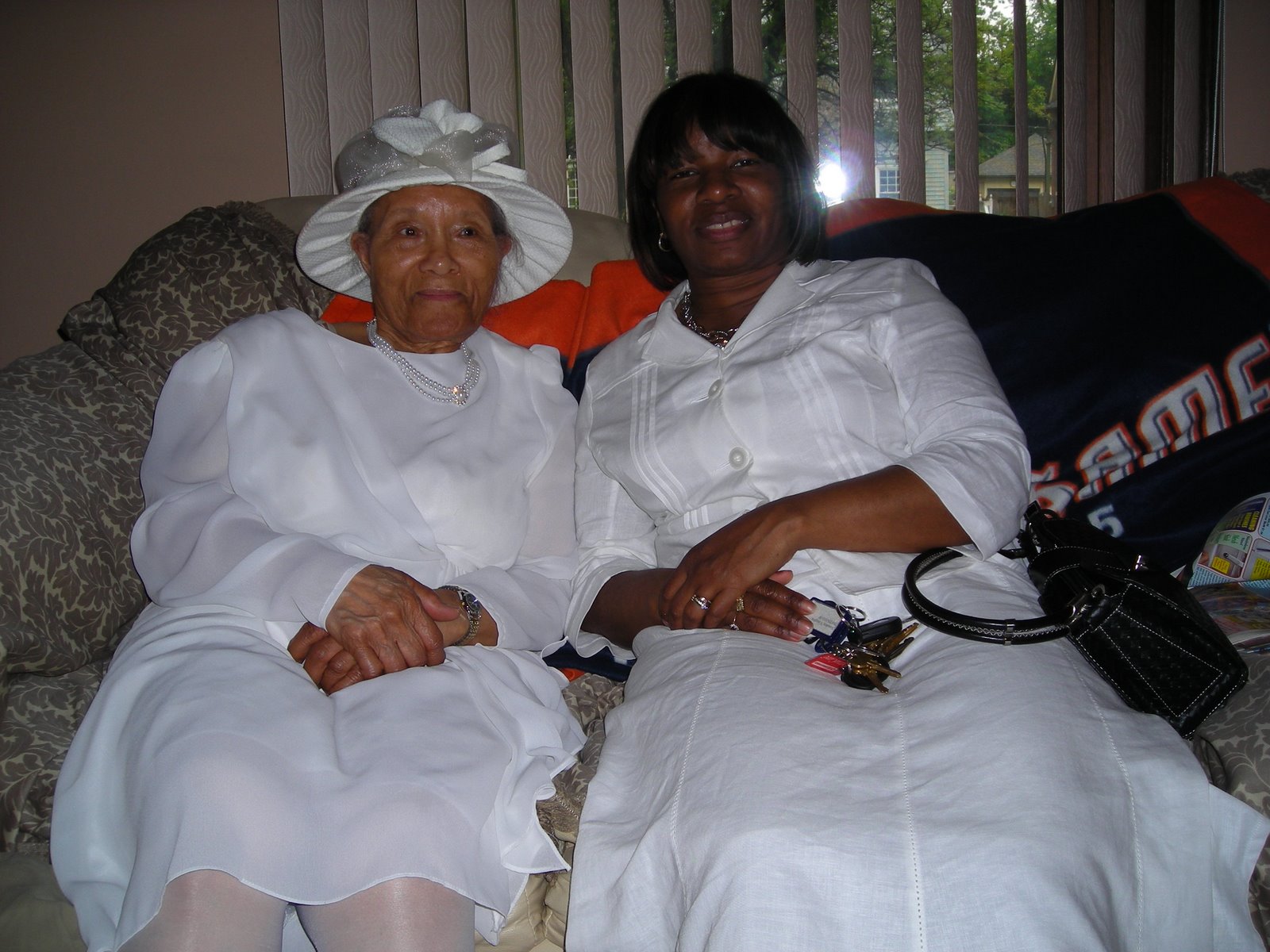
Mom and Libra, my oldest daughter


Mom and I


My Thanksgiving break was great, even though I had a paper to work on. I got a chance to hang out with my long time friend, Haniyyah Zakiyyah Rhodes, an empowered sista friend who likes to talk and run her mouth as much as I do. She is a wise elder versed in nutrition and is multi-talented as a barber that specializes in natural hair care, small business management, and entreprenureship.

I stayed with my daughter Libra and her boyfriend Sammy.

I trust everyone else had a great time with family and friends!

Hangin' Out in the Motor City with Family!


L-R Mrs. Elvina W. Vaughn (my mom) and Mrs. Sandra Vaughn (my sister-in-law)


L-R Jennie (my niece)and her son; Sandra Vaughn and Rev. Michael Vaughn (my youngest brother. I have five)


L-R Libra M. Finley (my oldest daughter) and Qiyamah - Summer of 2007


My youngest sister Jackie and her granddaughter


Jennie and her son

Saturday, November 17, 2007

Ordination Pictures


L-R Rev. Dr. Qiyamah A. Rahman, Kaleema Haidera Nur (my younger daughter) and Libra Malika Finley (my oldest daughter and child).


We were small in number but big in spirit!


It was a day for lots of hugs!


The Choir of the UU Church of Charlotte sang like angels and offered a range of music including: Wade in the Water, Every Time I Feel the Spirit, and the choral postlude was Siyahamba, a South African freedom song that they sang in honor of my plans to begin my ministerial career in South Africa. Jennifer McLeod, soloist (first row far right) sang I Believe I Can Fly and made me cry.


L-R Rev. Dr. Qiyamah A. Rahman and Rev. Leslie Takahashi Morris leading up to the Laying on of Hands Ceremony.


Charles Thomas on the right and friend opening up the Ordination Ceremony with drumming

Ordination Ceremony
Well, my pictures have arrived and I have relived my ordination all over again. Here are a few pictures that captured this wonderful day and event that I wanted to share with everyone!

Sunday, November 11, 2007

Police Killings in South Africa on the Rise

I plan to do some investigation to determine if this news report is valid. It comes from a racist blog written by a South African that is an unabashed and avowed racist. However, the content of these two postings concerned me. If anyone is able to obtain info on either story I would appreciate it.
Blessings! Rev. Dr. Qiyamah A. Rahman

Johannesburg - More policemen were murdered in the eleven years after the advent of democracy in SA in 1994 than in the eleven years preceding SA's political transition, the South African Institute of Race Relations said on Monday.

"The research found that between 1983 and 1993, about 1 152 policemen were murdered. Between 1995 and 2005, a staggering 1 894 were murdered," the Institute said.

This indicates an increase of 64%," said Kerwin Lebone, the Institute's researcher who compiled the statistics.

Lebone said that if there were any South Africans that had to date failed to grasp the seriousness of criminal attacks on SA "these figures should shock them out of their complacency".

He said the murder of many policemen before 1994 was allegedly politically motivated, because liberation movements regarded the previous government as illegitimate, and encouraged attacks on that administration's personnel and institutions.

"There seemed to be no political motivation for the continued attacks on policemen after the political settlement of 1994," said Lebone.

He said the increase in the number of murdered police and the huge leap in aggravated robberies were of serious concern.

More disdain

Criminals seemed to be showing more disdain for the security forces of the present government than they did for the previous one.

Lebone also warned the government not to surrender its citizens' rightful monopoly on the use of force for self-defence to criminals.

"The continued brazen attacks on state institutions and personnel responsible for the safety of South African residents and citizens amounts to an attack on the state itself.

"Public trust and confidence in the ability of the state to protect them will be eroded if the state cannot be seen to defend itself," he said.

Lebone said the danger existed that the public would lose faith in the legitimacy of state institutions and begin to increasingly take the law into its own hands.

Posted by Dark Raven at 2:29 AM 7 comments

Azanian Cops Beat Woman into A Coma

If you Want Peace - Work for Justice!
See story below:

Wednesday, January 17, 2007
Azanian cops beat woman into coma


Image: Comatose woman after savage police assault

17 January 2007

A Pretoria woman is fighting for her life in hospital after being brutally assaulted by Sunnyside police officers. The assault, part of which was photographed, involved plainclothes policemen attacking a prostitute.

Pretoria News photographer Herbert Matimba started photographing the attack but was forced to flee after police turned their attention to him. He spent the night in hiding to prevent police confiscating his photographs. 'She was just hanging in his arms as he dragged her across the pavement'

Paramedics, who rushed to attend to the black woman who lost consciousness after an apparent "epileptic fit", were spotted carrying the woman's diminutive body on a stretcher to an ambulance - her blue sandals and pink handbag wedged beneath her feet.

Uche Kalu said he witnessed the attack on the woman outside Malet Flats where he lives. "It was extremely brutal. I had just bought cigarettes from a vendor on the corner of Johann and Arcadia streets outside our block of flats, when I heard women screaming. "As I turned around, I saw two policemen grabbing two women and throwing them to the ground before grabbing one of the women and pushing her into the back of the police van. As one of the policemen pushed the woman into the van the other tried to grab hold of the other woman, who began fighting back," said Kalu.

"That was when one of the policemen grabbed her by the head and began smashing her head against the van's back doors. The woman fell to the ground where she was kicked in the head and stomach.

'A policeman is meant to arrest criminals'

"I could hear the policemen swearing before one of them picked her up and began strangling her. "She was just hanging in his arms as he dragged her across the pavement and threw her against the van several times before she started convulsing and shaking," he said. Kalu said that as people began screaming, a photographer began taking pictures. "When the policemen saw him they told him to stop before trying to grab him. I yelled at him to run and he did. I do not know where he went but I could see the policemen searching all the flat floors, waking people up as they looked for him.

"It is ridiculous. A policeman is meant to arrest criminals. If someone is shooting at a policeman then they should shoot back but they have no right to beat up someone who is not threatening them." Matimba's girlfriend, Mpule Mashiane, said she had been terrified. "I heard Herbert park his car, but when he did not come inside, I went to look for him. "As I opened the front door, there were two policemen and a policewoman standing outside. "They pushed me aside and began opening cupboards and looking under the bed, screaming at me to tell them where Herbert was.

"When I said I did not know, they took my cellphone and tried to phone him and told me I must tell him to surrender and come with them to the police station. "When I asked them what had happened they said he had taken an illegal photo of a 'patient' they were trying to help and that he must surrender or else they would arrest him," she said.

Nomsa Zulu, who hid Matimba, said she had been terrified and had not known what was happening. "I was talking to friends when a photographer ran to us and pleaded for help. "When he told us what happened I rushed him to my room." "We could hear policemen walking up and down our passage banging on doors screaming for him to surrender. "I was scared that they would find him and hurt him," said Zulu.

Tshwane Emergency Services spokesperson Johan Pieterse confirmed that medics had taken the seriously injured woman to Pretoria Academic Hospital after they received an anonymous telephone call for help saying that a woman was having an "epileptic fit". A paramedic said the woman had suffered severe head, neck and internal injuries as well as severe bruising. A Pretoria Academic Hospital nurse said the woman had sustained severe trauma as a result of a serious assault. She said the injuries could not have been caused by an epileptic fit. "It is as though someone has bashed her on the head with a heavy object," said the nurse.

Pretoria police spokesperson Inspector Anton Breedt said that the allegations of intimidation against Matimba would be investigated as well as any other wrongdoing which had led to the assault.

Source:

Posted by The Uhuru Guru at 11:42 PM

Saturday, November 10, 2007

Hidden Treasures: The Voices of Women in Judaism, Christianity and Islam


Downtown Chicago at Night


Lake Michigan at the Point!


Another beautiful scene at Lake Michigan in Chicago, IL

On Monday, November 5 at 8AM I had a tooth extracted. By 9:30AM I was sitting at the Catholic Theological Union listening to a panel discussion on recoverng the voices of women and addressing challenging and problematic texts. In a truly interfaith worship service they began with a Jewish prayer at 8:30AM. At noon we had a Christian prayer and at 5PM a Muslim prayer.

Jewish Prayer

Parts of the Jewish prayer were conducted from the book, Gates of Prayer for Shabbat and Weekdays: A Gender Sensitive Prayerbook by Chaim Stern, editor. Rabbi Ellen Weinberg dreyfus read from the Torah and the prayer service included a cantor.

Midday Christian Prayer
For this prayer we recited the following:
Leader: O God, come to our assistance.
All: Lord, make haste to help me.
Leader: Glory, honor and worship to God, to Christ and to the Holy Spirit:
All: AS it was in the beginning, is now, and will be for ever. Amen. Alleluia.

We sang Lord of All Hopefulness and Psalm 95. We then recited prayer and someone read scripture form Isaiah 55:8-11. We had a brief silence, followed by prayers of intercession, the Lord's Prayer and a concluding prayer and blessing.

Muslim Prayer
I did not attend the 5PM Muslim prayer because I did not have anything appropriate to cover my head and I was not wearing a ankle length dress. Muslim planners included the following handout for non-Muslims:

The prayer in Islam consists of a unit that is repeated twice, three times or four times depending on the time of the day.

The unit starts in the standing position. The first chapter of the Quran "The Opening" is recited:

In the name of God, the All-Merciful, the Mercy-Giving.
All praise is for God alone, Lord of all the worlds.,
The All-Merciful, the Mercy-Giving,
Master of the Day of Judgment.
IT is You alone we worship and it is You alone we ask for help.
Guide us along the straight path
The path of those upon whom You have bestowed grace,
Not those upon whom there is wrath,
Nor those who have gone astray.

The next step is bowing, during which God the Almighty is exalted.
The third step is prostration, during which God the Most High is exalted.
The last step is sitting, during which supplications and greetings for Prophet Muhammad, Prophet Abraham and their families are given.

The Principles of Dialogue are worthy of use in other interfaith gatherings and so I include them here for your reference:

1. We should recognize that no single group or viewpoint has a complete monopoly on the truth.
2. We should not envision ourselves or any group as the saving remnant.
3. We should test all proposals for their pastoral realism and potential impact on individuals as well as for their theological truth.
4. We should presume that those with whom we diff ere are acting in good faith.
5. We should put the best possible construction on differing positions.
6. We should be cautious in ascribing motives.
7. We should engage the realities of contemporary culture, acknowledging the culture's valid achievements and real dangers.

Amen and Blessed Be! Rev. Dr. Qiyamah A. Rahman

Collegium: An Association for Liberal Religious Studies


Craigville Conference Center in Cape Code near Providence, Rhode Island where I attended the Collegium Conference.

Another beautiful nature scene from the Craigville Conference Center


Heavenly sunset!

One of many beautiful sunsets! The next day a hurricane hit nearby bringing gale rains and high winds.

Collegium held its Annual Fall Conference November 1-4, 2007 at the Craigville Conference Center on Cape Cod. Collegium is an Association for liberal religious studies whose mission is to "bring together the best academic, ministerial, lay, andother resources to bear upon the intellectual life of Unitarian Univeralism through encouraging, sharing, and distributing scholarly and other creative work." Each conference features a distinguished guest. This years distinguished guest was Father Daniel Berrigan, one of the country's leading peace activists of the past half-century. Father Berrigan is a Jesuit priest, poet, pacifist, educator,social activist, playwright and lifelong resister to what he calls "American military imperialism." He recently celebrated his 85th birthday.

Thanks to a scholarship from Collegium, I had the opportunity to hang out with some high powered researchers and scholars. The format included research and research in progress in several categories that included: history, theology,ethics,and social justice. I presented my dissertation research on Clergy Sexual Misconduct under the ethics category. I posted another paper on Diversity and Religious Education but decided not to present it.

While there were a number of excellent presentations, my favorite was by far, Jane Rosecrans on Frances Ellen Watkins Harper. Harper is one of my favorite sheroes! I was delighted to meet Jane and hear about the things she is doing.

Rev. Kim Beach, a minister that I knew previously from Lynchburg, VA where he served as Interim, shared his insights and experiences from a recent trip to Israel and Palestine.

Rev. Victor Carpenter was also present and presented a response to Bill Schulz's Berry Street Essay titled, What Torture Taught Me. Victor spent a number of years at the Cape Town, South Africa congregation as minister. Another important connection we have is his interest in the Black Empowerment Era. He has conducted and written the most extensive history on the Era in the UU Movement/denomination.

It was a delight to meet Myriam Reynaud. We both were trying to recall where we had met and realized it was at Wednesday evening Vespers at First Unitarian Congregation in Chicago, IL. She attends the University of Chicago and I attend Meadville Lombard Theological School. As Unitarians, we both attend Vespers. Because of my class schedule I am seldom able to attend, hence my poor memory. (What is your excuse Myriam?)I also ran into another "classmate," Rudra Dundzila that presented on Domas Sidlauskas-Visuomis. He and I both took a course, Hebrew Bible, on line together. While I was not able to attend his presentation I know that his scholarship is stellar.

I roomed with Betty Hoskins, a long time UU Women's Federation member and past Feminist Theology Chair. We talked about my research and the possibility of my doing a General Assembly presentation as well as potentially publishing and presenting my recommendations and findings on clergy sexual misconduct through the UU Women's Federation.

In regards to other research I am conducting, once this semester has concluded I will focus on writing up the conclusion for my research on African American Unitarian and Universalist and Unitarian Universalist women that was funded by the UU Women's Federation.

I would like to thank Rev. David Johnson and his gracious wife, Julie Coulter, for their warm hospitality. Yours truly scheduled a return flight for 6AM to Chicago with a two hour layover in Atlanta. As a result I was forced to leave the conference early on Saturday instead of Sunday. However, I was able to ride to Providence, RI with Rev. Paul Sawyer and Father Berrigan. What an earful hearing about their adventures over the years. We had a close encounter with Paul almost missing his train. He ended up handing his keys to his rental car that he was unable to return because they were closed and there was no drop box. Julie Coulter and I spent the next hour trying to return the car. I ended up keeping it overnight and driving it to the airport the next morning, thus getting me to the airport and getting the vehicle back where it belonged! What a win-win situation!

Collegium 2008
I had not expected to attend the 2008 session even though I suggested that they invite Mark Morrison Reed as their "Distinguished Guest." They followed up on the suggestion and he accepted! I have to figure out how to get myself there next year!

Blessings! Qiyamah A. Rahman

Mothers, Sisters, Daughters, Across the Waters


Rev. LaDonna Sanders speaking to sisters in Chicago, IL about her vision for Mothers, Sisters, Daughters and her dream to link it to the Mothers, Sisters, and Daughters in South Africa component.


Rev. Franshon Salter, one of the participants that came to contribute her support to Mothers, Sisters Daughters, Across the Waters


A group picture marking the conclusion of the first meeting of Mothers, Sisters, Daughters, Across the Waters - L-R Rev. Franshon, Rev. LaDonna, Rev. Dr. Qiyamah and Mama Dawn holding Justice (4 months).


Kitchen Table Talk! Breaking bread together after talking, praying, and scripture reading. L-R Rev. Franshon, Rev. LaDonna, Mama Dawn and Justice.