Thursday, June 24, 2010

Belated Reflections on Father's Day


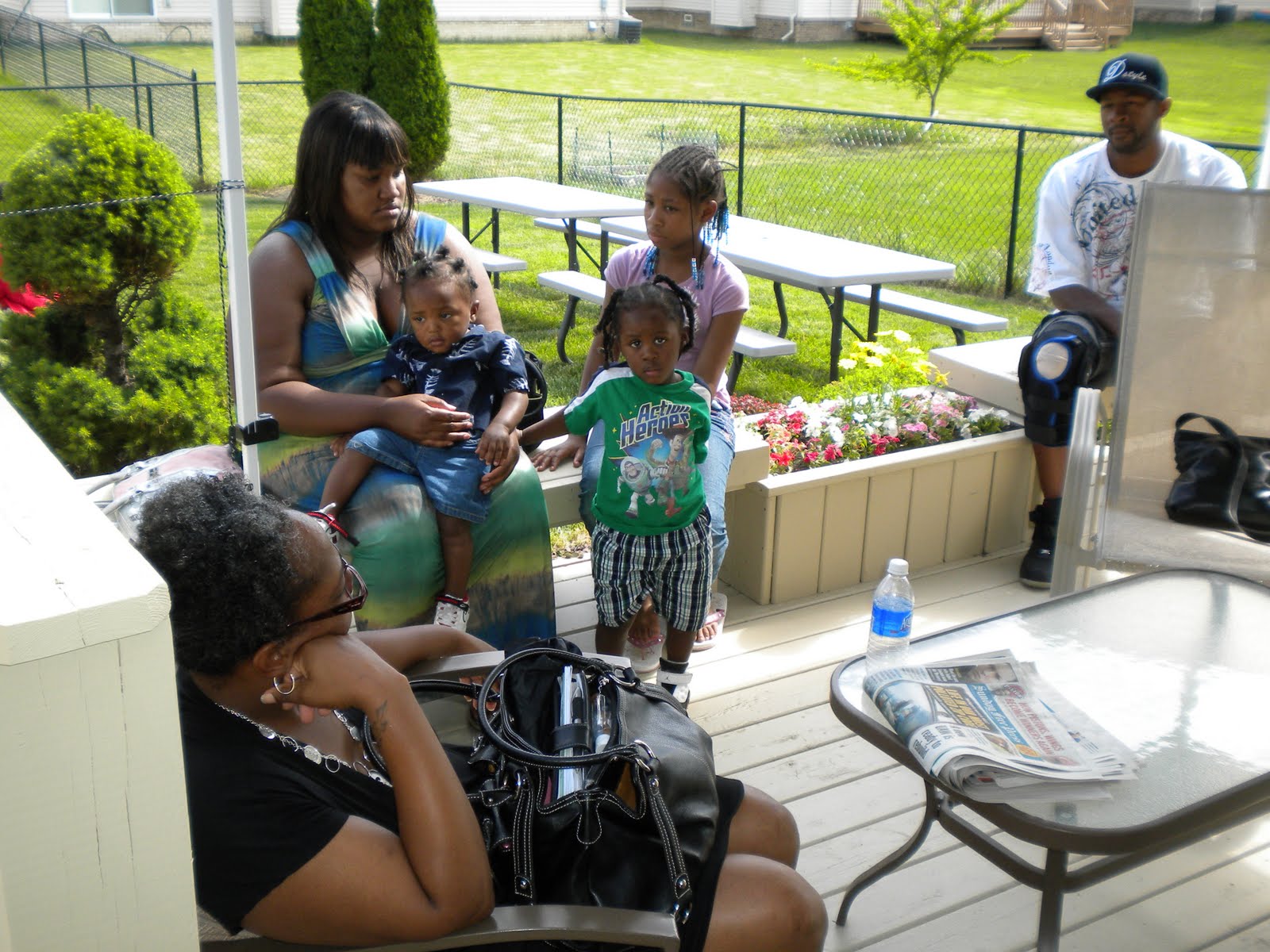
I recently took the train to Ann Arbor, MI to hang out with my family. We were celebrating Father's Day. My youngest sister Jackie lives in Ypsilanti, MI. She and her husband are truck drivers and they usually spend their time hauling loads all around the country. She was a short order cook in a previous life and loves to cook. She has recently bought a HUD house that she fixed up. It is her pride and joy.

It was great seeing family that I have not seen in a while. And the food was great!

It is so easy to take our loved ones for granted, to be short tempered and ill acting toward them or worse yet to ignore and neglect them. One is particularly vulnerable to this if you live away from your family like I do. I call my children, my daughter in law, my mom and two of my sisters. I talk infrequently to my brothers and my other sisters and almost never call my nieces, nephews and cousins. I usually wait until family reunions and holidays to see everyone.

So one day when three of us were on the phone we talked about putting together a small BBQ to bring everyone together. This BBQ would be a way to let the fathers in the family know how much we love and appreciate them. It would be a small gesture but imagine if we were more intentional about doing this in various aspects of our lives? What a difference it would make.

Besides seeing everyone and falling off my diet, Sunday I had the opportunity to hear my younger brother preach and hear his testimonial. He was saved at 19 years old. He will be 50 next year. As he tells the story, my mother had given up on trying to make him a productive citizen and well rounded human being. So she decided to turn things over to god. At the time he thought that was the best thing that could have happened. He was coming and going when he wanted to and hanging out with his buddies, smokin' and drinkin'. Then he got in trouble and was facing 5-15 years in prison. That was when he took a hard long look at his life and decided to in his words, "serve god and not the devil".

While our theologies are very different and I do not believe in heaven or hell or the devil I love his very compelling testimonial. Life has a way of getting our attention! We can heed it or ignore it. The choice is ours! Intentionality and taking responsibility for our lives is key to creating happiness in life.

Q. How can you step up and take more responsibility for those things you want to change in your life? What is your pattern of change? Do you resist change? Do you wait until things get so bad that you have to have the universe/god knock you on your behind before you take action?

Q. What do you need to change in your life to fully be the loving and wonderful human being that Spirit/god is calling you to be? Who are you called to be in the world?

Blessings! Rev. Qiyamah

Wednesday, June 23, 2010

Stories for the Journey: Creating Multiracial and Multicultural Congregations


Workshop presenters at Strategies for Growing Inclusive Multicultural Congregations and Ministries

L-R Lynn Anderson - member at UU Congregation of Atlanta (UUCA)and Rev. Anthony Davis, minister of UUCA


L-R Lynn Anderson, Rev. Anthony David,Senior Minister at UUCA in Atlanta, GA; Rev. Marlin Lavanhar, Senior Minister of All Souls Unitarian Church; Rev. Elizabeth Lerner McClay Silver Springs; Rev. Kathleen Rolanz at Rocky River UU Church in Rocky River, OH and Sunshine Jeremiah Wolf, intern at Rocky River UU Church.


Please find below a rich resource list obtained from Taquina Boston, Director of Identity Based Ministries at the Unitarian Univeralist Association in Boston, MA.

Each year several thousand Unitarian Univeralists attend several days of the General Assembly (GA) in different locations around the country. This years GA is being held in Minneapolis, MN. I facilitated a panel titled, Stories for the Journey: Creating Multiracial and Multicultural Congregations. This unique panel of ministers and laity shared their cutting edge journey stories that were warmly received by the attentive audience. The panel consisted of: Rev. Rob Hardies, All Souls Church Unitarian, Washington, DC; Rev. Dr. Fred Muir, Senior Minister and Rev. John Crestwell, Associate Minister at UU Church of Annapolis; Rev. Marlin Lavanhar, minister at All Souls Unitarian Church in Tulsa, OK and Ms. Taquina Boston, Director of Identity Based Ministries with the Unitarian Universalist Association.

Please find the resource list below:

Question: What are you and your faith community doing to make your church/mosque/synogogue/temple welcoming to diverse individuals?
Blessings! Rev. Qiyamah


Creating Multicultural Congregations Resource List:


People of the Dream by Michael O. Emerson


Against All Odds: The Struggle for Racial Integration in Religious Organizations, Korie L. Edwards and Michael O. Emerson


The Elusive Dream: The Power of Race in Interracial Churches, Korie L. Edwards


The Power of Stories: A Guide for Leading Multiracial and Multicultural Congregations, Jacqueline J. Lewis


One Foot Planted in the Center, the Other Dangling Off the Edge: How Intentional Leadership Can Transform Your Church, Gordon L. Dragt


The Next Evangelicalism: Freeing the Church from Western Cultural Captivity, Soong-Chan Rah


Building A Healthy Multi-Ethnic Church, Mark DeYmaz


List of multicultural congregation resources developed by Alicia Forde and Janice Marie Johnson:

the Diversity of Ministry initiative (uua.org website - , including a recent story about the first 2 settlements – UU Church of Pittsburgh, PA (Rev. Alma Crawford) and UU Church of Annapolis, MD (Rev. John Crestwell) are included on the UUA website. A few URLs are listed below. Also search at uua.org using “Diversity of Ministry.”

http://www.uua.org/news/newssubmissions/151377.shtml

http://www.uua.org/leaders/leaderslibrary/leaderslibrary/interconnections/119956.shtml

http://www.uuworld.org/news/articles/11198.shtml

http://www.uuworld.org/life/articles/145503.shtml

Additional Sources:

The UUA will release the DVD and study guide for the UU University Multicultural Track in November. Meanwhile, contact Diane Martin to get copies of the “Now Is the Time: Leading Congregations Into a Multiracial/Multicultural Future” conference DVDs. There have been 3 conferences . The last DVD from 2009 was in production.

Thursday, June 3, 2010

Prayer for Forgiveness, Hope and Reconciliation


(During our times of crisis life is like a desert - dry and unyielding as we struggle to find nourishment and renewal - hoping to find the means to sustain us on this journey of life.)

Wednesday night I responded to an invitation I received and visited the Calvert House, the Catholic Center at the University of Chicago. Many of you are aware of my interest in interfaith dialogue. At the time I responded I was not aware that this gathering was a "prayer for forgiveness, hope and reconciliation" for the misconduct of Catholic priests recently revealed by the media. A student had evidently approached Father Pat, the Director at the Center about conducting the service. Since I had not been following the news I sat present with a sense of deja vu hearing the pain and anguish expressed by the students. Those of you that know me are aware that I did my dissertation research on clergy sexual misconduct in the Unitarian Universalist Association. While my degree was conferred in 2007 I began my research around 2004. Listening to the students and the priests conversations about recent occurrences it almost appeared that nothing has changed except recognition of its global context. This global misconduct now removes the perception that somehow American decadence was a result of the clergy misconduct in this country.

A total of eleven students attended. All but one of them was Catholic. The other was Disciple of Christ.

Here is an excerpt of a prayer, A Song of Christ's Goodness from Saint Anselm of Canterbury that was recited:

Jesus, as a mother you gather your people to you; you are gentle with us as a mother with her children.
Often you weep over our sins and our pride, tenderly you draw us from hatred and judgment. You comfort us in sorrow and bind up our wounds, in sickness you nurse us and with pure milk you feed us. Jesus, by your dying, we are born to new life; by your anguish and labor we come forth in joy. Despair turns to hope through your sweet goodness; through your gentleness, we find comfort in fear.
Your warmth gives life to the dead, your thought makes sinners righteous.

Lord Jesus, in your mercy, remake us. In your compassion, bring grace and forgiveness, for the beauty of heaven, may your love prepare us.
Amen.

The rest of the service was modeled after the 2000 "Day of Pardon" Service by His Holiness John Paul II in which participants confess their sins, repent and ask God's forgiveness. After each reading there was a moment of silence and after each confession and prayer a candle was lit on the candelabra at the front of the Chapel.

The service was ended with a very moving prayer and we dismissed, exchanged the greeting of peace and I departed.

Q. What have you recently done to promote healing where there is dis-ease and pain? to promote justice where there is injustice? and to stand with the marginalized?

Blessed Be! Rev. Qiyamah

Friday, May 28, 2010

Conflict at University of Puerto Rico


I am always interested in what is going on in academia. Please find below info on the conflict at the University of Puerto Rico:

Dear colleagues, students, and friends:

As many of you already know, students at the University of Puerto Rico have been on strike for 37 days now and have de facto paralyzed all but one of the eleven campuses that comprise the system. At the core of this conflict is the future of public higher education in Puerto Rico. This includes critical issues concerning the current state budgetary crisis and its potentially detrimental effects on the life of the university, but it also bears upon questions that go beyond economic matters, as we hope the information enclosed below makes clear.

Even though talks between students and the university administration have recently resumed, the situation is still volatile and rather precarious. Students have been beaten by the police as recently as last week, and riot squads have been deployed, and are still on call, to siege university campuses all around the island. Two weeks ago Police Chief José Figueroa Sancha, with the support of university authorities, forbade water and food supplies to students who are occupying the main campus of the system (Río Piedras). This measure was finally withdrawn after much outrage from the community. Most recently, this past Monday a student, Natalia Sánchez López, died from unknown causes following her participation in a student assembly on the Mayagüez campus. University authorities had ensured that this gathering would take place in uncomfortable and potentially harmful conditions in order to discourage participation. Many students were treated for dehydration throughout the proceedings, and an investigation into Natalia’s death is still under way. Finally, yesterday several thousand protesters, of all ages and backgrounds, marched on the capitol building and the governor’s mansion in support of the students’ demands.

For your information, we are enclosing here a link to a segment on Amy Goodman’s program, Democracy Now, that addresses this current crisis, a link to a NYT article on the strike, and both the original Spanish version and an English translation of the Declaration of Puerto Rican Academics in the US (originally published in Spanish on May 20, 2010 and signed by 65 professors) in which we discuss some of the deeper implications of the conflict. Below you will also find two additional links: 1) to the students’ news service (Desde Adentro-rojogallito); and 2) to the strikers’ own radio station (Radio Huelga).

As this situation has received so little coverage outside Puerto Rico, some of us have deemed it important to send this information to our networks. Please help us to disseminate it by sharing it with your lists.

Many thanks,

Agnes Lugo-Ortiz, The University of Chicago

Aldo Lauria-Santiago, Rutgers University

Ivette Hernández-Torres, University of California, Irvine

Luis Avilés, University of California, Irvine


Amy Goodman, Democracy Now

http://www.democracynow.org/2010/5/17/student_strike_at_university_of_puerto


NYT Article on PR Student Strike
U.S. | May 21, 2010

Student Protests Tie Up Campuses in Puerto Rico

By OMAYA SOSA-PASCUAL and EMMA GRAVES FITZSIMMONS

Most of the University of Puerto Rico system has been shut down by students seeking greater transparency.

UPR Student News Service, Desde Adentro-rojogallito

http://rojogallito.blogspot.com/

Radio Huelga

http://radiohuelga.com/wordpress/

Racial Profiling in Arizona

Below is a statement by The Diverse and Revolutionary Unitarian Universalist Multicultural Ministries (DRUUMM), an organization of UUs of color and Latina/o ministers, religious educators, seminarians and staff comprised of individuals that come together to support and advocate for one another, their colleagues and their ministries.

Question: What are you doing to build and support bridges between people?
Blessings! Rev. Qiyamah

May 28, 2010

DRUUMM (Diverse and Revolutionary Unitarian Universalist Multicultural Ministries) join with other Unitarian Universalists concerned with justice to condemn the new racial profiling laws in Arizona and we urge Unitarian Universalists who identify as people of color/Latina/o/Hispanic to express their outrage individually and collectively at these laws which allow law enforcement to target people based on race. We particularly note the statement by LUUNA (Latina/o Unitarian Universalist Networking Association) which notes about this law that “its very vagueness will provide a means for law enforcement agencies to harass individuals on the basis of appearance alone.”

Because some of our members have indicated their concern that they would not be safe travelling to and within Arizona as long as such racial profiling laws exist, we also support the proposed boycott of General Assembly. To hold a General Assembly without the total spectrum of our members is exclusionary. We also urge our General Assembly delegates this year to explore other options that could keep us in dialogue with the people of Arizona.

We remind our Unitarian Universalist family that such actions do have impact. In the late 1980s, when Arizona refused to honor the Martin Luther King holiday, Unitarian Universalists cancelled the General Assembly scheduled to be held there. After the state changed their position, General Assembly was once again held in that state. We believe that, even in hard economic times, Unitarian Universalists must be willing to demand that their money be guided by their principles.

We as people who affirm the worth and dignity of all people must continue to fight against racism and ethnic discrimination in all forms. A law that singles people out by race and ethnicity is by its nature racist. We condemn this law and urge people of faith throughout our country to let their voices be heard.

For The Steering Committee

DRUUMM (Diverse and Revolutionary Unitarian Universalist Multicultural Ministries)

Rev. Danielle Dibona, President

Robette Dias, Treasurer

Clyde Grubbs, Event Coordinator

Rev. Leslie Takahashi Morris, First Vice President

David Yamashita, Asian Pacific Islander Caucus Chair

Sunday, May 23, 2010

Tragedy for One of Us Constitutes Tragedy for All of Us

A beautiful 7-year old girl, Aiyana Jones was recently killed when police in Detroit invaded her home under the guise of executing a police raid. Aiyana Jones was peacefully sleeping on a couch in her home when she was fatally shot in the neck by a police officer during a raid on the house allegedly targetting a homicide suspect. It appears the police instead targeted the home of an innocent family.

CBS reported that neighbors told [the] police [that] there were children in the house, and showed them toys in the front yard. However, the police allegedly proceeded to throw a flash grenade through the window of the home despite the warnings.

The tragic incident was reportedly caught on tape by a television crew that was following the police while filming the raid for a crime show.


Aiyana had been sleeping on a living room sofa about 12:40 a.m. Sunday when she was struck by a bullet from a gun carried by a member of the Detroit Police Special Response Team. Officers entered the downstairs flat of the two-story duplex in the 4000 block of Lillibridge on the city's east side after throwing a stun grenade through the glass of a front window.

A video crew with "The First 48" cable TV show was recording the scene as the cops executed a warrant for Chauncey Louis Owens, 34, wanted for the May 14 slaying of a Southeastern High School senior. Owens was captured as officers simultaneously raided the duplex's upstairs unit -- without exploding a stun bomb.

Owens has since been charged with murder in the shooting death of 17-year-old Jerean Blake.

Officer Joseph Weekley, a member of the Detroit Police Special Response Team, has been identified as the person who shot Aiyana. The 14-year veteran of the force has been placed on a desk job while the incident is investigated.

Police said there was some level of contact between Aiyana's grandmother and Weekley after he entered the home and that led to the shooting.

A lawsuit has been claiming negligence, civil rights violations and a police cover-up of the true facts.

(source: From The Detroit News: http://www.detnews.com/article/20100522/METRO/5220375/1409/METRO/Rev.-Sharpton-to-give-eulogy-at-Aiyana-Jones-funeral#ixzz0odjVwaAP

Reflections

What a painful loss and tragedy for the parents. My heart goes out to them. But we must share in the parents grief and outrage if these facts are correct as reported. How can life be rendered so cheaply by those designated to protect us? How can they profess to uphold the law and be so inconsiderate of the humanity and rights of citizens? The recklessness out of which the police appeared to act reflects a historic alienation rooted in racism that I had thought had begun to dissipate in most instances. Whether this reflects an aberration remains to be seen. I pray the day will come soon when we are healed of the disease of racism and all the other isms that corrupt human relations

Q. When are we compelled to step forward and speak out less we compromise our humanity and become less than human?

Pray like hell for justice and then get up and fight like hell to claim it!
Rev. Qiyamah

Friday, May 7, 2010

II Annual Freedom Weekend

I was recently in Austin, TX, AKA ATX for the II Annual Freedom Weekend held April 29to May 2, 2010. While I helped out in different venues my primary role (besides supporting my daughter, Kaleema Haider Al-Nur) was as one of the guest speakers for the Interfaith Worship Service held on Sunday, May 2. Each of the four clergy delivered ten minute mini-sermons:

Rev. Dr. Joseph Parker, Senior Pastor, David Chapel Missionary Baptist, Austin, TX
sermon - Rebooting Justice

Cardinal Aswad Walker, Shrine of the Black Madonna, Houston, TX
sermon - Why Do You Cry to Me So? Tell the Children of Israel to March On. Exodus 14:15

Rev. Dr. Qiyamah A. Rahman, Director of Contextual Ministry and Senior Lecturer at Meadville Lombard Theological School, Chicago, IL
sermon - On the Road to Beloved Community

Robert Muhammad, Nation of Islam, Austin Study Group, Austin, TX
sermon - The Science of Freedom

WHAT IS FREEDOM WEEKEND?
BLACK FREEDOM WEEKEND 2010 featured 4-days of discussions, Films, performances and trainings!

Annual Black Freedom Weekend featured a gathering of individuals and community groups and organizations, convened by Community and University organizers and partners to confront major issues that impact Black communities in Austin [and throughout Texas] as human rights issues. The Weekend included some exciting venues featuring: a film festival, community forums with keynote speaker, Ajamu Baraka, Executive Director of the U.S. Human Rights Network. His presentation was titled, From Civil Rights Back to Human Rights: Recapturing the Spirit of Revolutionary Change. Freedom Weekend Kickoff Night featured an elder activist, African Martial Arts (stick fighting and a version of Capoeira) and slamming guest poets delivering spoken word. The largest gathering occured on the last day when white allies convened to talk about gentrification in Austin.

FW fosters practical strategy-making, community building, truth-telling, critical dialogue, and creative collaborations and coalitions by inviting a variety of voices to the table during activities held at different locations throughout the Community. Freedom Weekend is:
* Community Art Show & Performances
* ‘Bringing Human Rights Home’ Community Forum
* Sunday Sermon
* ‘People Get Ready’ Community Workshops

Annual Freedom Weekend is Housed at: the Warfield Center for African and African American Studies and the Department of African and African Diaspora Studies at the University of Texas.


[2010] II Annual Freedom Weekend: This year’s Freedom Weekend focused on naming the collection of Systems, policies and practices that work in concert to produce a Push-Out/Pull-Out effect of Black communities or Black Community Displacement. As the size of the Black community in Austin continues to shrink, we ask: WHERE ARE BLACK PEOPLE GOING AND WHAT’S GOING ON WITH BLACK PEOPLE!? Last years focus and theme was
"Bringing Human Rights Home."

Question: What are you doing in your community to bring together segments of people that do not usually communicate such as the residential community and academia; grass roots activist and policy makers/legislators and politicians?

If you are currently not doing anything what can you begin to do? Who do you need to collaborate with? Who are the existing players?
Blessings! Rev. Rock (Rahman)

Get in Where You Fit In!

This post features a potpourri of events that you may or may not be able to relate to. Hence, the title, get in where you fit in.
Enjoy!
Rev. Qiyamah


Politics of Black Women's Hair


At the risk of setting off a deluge of comments (good for the blog - bad for my peace of mine), I have a confession to make. I recently put a light relaxer in my otherwise natural hair. Given that I have worn my hair natural since I was 18 years old and I am now turning 62 I think I can exercise the freedom to explore my hair options without having the the hair police called down on me. The fact that I am very embarrassed to admit this simple fact (Hey! I'm a grown ass woman!) is a sad commentary on the politics of black women's hair. But I reserve the right to be in relationship with my hair however I choose. Besides, I have demonstrated my commitment to natural hair and the polics of natural hair at almost 62. And I have earned the right to make my own decisions about my hair. For those of who that do not know the roots from whence this conversation flows then you have not been paying attention! I do not have the time or patience to school you. Google something like "politics of black women's hair" or "natural vs straightened hair debate."


Here is a picture of the culprit. I chose this product because it does not contain lye. It went on easily, had no odor and did what it said it would do - relaxed my hair. I left it on for 15 minutes. If I had known that my hair texture did not require 15 I would have probably left it in for less time. What I noticed after I rinsed it out is that the "curl/kink" that I slightly straightened also provided body and once I did not have the curl/kink I had less body and my hair was not as full and able to form a natural crown but lay down like a domesticated dog. Did I take all the fight and umph out of my hair. lol I am on the verge of cutting it all off!!!!!!!!!!!!!!!

On a More Serious Note

I said it was not all that serious! And I have just the picture to prove it. This is a dog walker in downtown Chi Town doing his thing!

Ordination: Celebrating a Unitarian Universalist Ministerial Milestone

L-R Rev. David Bumbaugh, Rev. Beverly Bumbaugh, Rev.Rudra, Rev. Ed Searles, Rev. Jim Hobart (back to camera), Rev. Nan Hobart and Rev. Emmy Lou Belcher.

Two of my favorite Unitarian Universalist ceremonies are installations and ordinations. This is a picture of Lynn Garner's recent ordination held April 24 at
3rd Unitarian Church. The ordination marks the congregation's naming and blessing of a UU seminarian that has usually completed a Masters of Divinity and has been fellowshipped by the denominational credentialing body, the Ministerial Fellowship Committee.

Ministers and students in candidate status can process (march)in at the beginning of the ceremony and at the conclusion of the ceremony. Several will also participate in the service. An ordination usually features the following: hymns, readings, meditation, homily, charge to congregation, charge to minister and right hand of fellowship. The ordinee is usually gifted with a stole. The ordaining congregation and ordinee participate in a responsive covenant and the benediction is given and everyone convenes to a reception to indulge in food, drink and conversation.


L-R Rev. David Bumbaugh, Rev. Beverly Bumbaugh and Rev. Rudra


Theatre Gains Another Gifted Playwright

L-R unidentified staff person with Crossroads Theatre, Stephanie Berry and Artistic Director of Crossroads.

Sunday, April 18 I had the pleasure to travel to support my friend Stephanie Berry's endeavors in New Brunswick, New Jersey to witness an important milestone in a friends career. I was privy to the transition of Stephanie's craft from actor to playwright. The Court Theatre premiered Stephanie's play, the Last Fall. It is a love story between two individuals in the senior years of their life. Watching the play I realized an irony, that is, many of the same dynamics and challenges in love attachments are present across generations. Issues of trust, commitment, adjustments to one another and clarity about the relationship and common agreement about same are all similar across generations. The unique factors that aging partners appear to face is the recognition that one might have to settle because advanced age may preclude other options. Also, partners, usually the woman face having to compete with much younger rivals for love interests is another unique dynamic associated with aging love. Sexually active seniors also face more health concerns as they seek sexual pleasures with aging bodies and all the accompanying challenges.

The two protagonists, Lizan Mitchell (Rhea) and Roscoe Orman (Neville) meet and become enmeshed in a verbally combative relationship that is sometimes as toxic as it is loving. The couple treat the audience to their unique blend of intimacy moving back and forth between loving reminising of shared moments of playfulness and lusty sex to sharp and biting verbal exchanges punctuated by Neville's silences or ominous warnings, "you don't want to go there."

The play put me in touch with my own reflections and vulnerabilities about growing old and attempts to claim love and romance. How that process changes is not as obvious as how I have changed and what it means to seek a mature love in a changing world. Rhea and Neville overcome the biggest obstacle, how to meet potential partners, through their accidental meeting one night when Rhea is attempting to catch a cab. They are not going in the same direction. This might very well be the theme of the relationship. Rhea wants commitment and Neville is not sure whether he wants it although iot is obsious he craved love as much as Rhea. Rhea was more willing to take risks to secure it than Neville was. An ironic twist, Neville is an "emotional coward" and Rhea the warrior. Some of the basic differences between men and women are explored in this complex play. Differences about how men and women pursue love interests differently and how men often equate it as more about sex than romance. Rhea defies all those stereotypes and is at times portrayed as a card waving feminist/womanist who clearly will not let any man take advantage of her. She is quick witted and intelligent and feisty!

My regards to the playwright Stephanie Berry for a job well done! I suspect we will be hearing from her in the future and her career as a playwright looks more than a little promising!


L-R Stephanie Berry, John Martin and unidentified theatre goer.

Friday, April 23, 2010

The Passing of an Icon


Dr. Dorothy I. Height, in the words of Maya Angelou, was "one of the giants among mighty women." I join millions in mourning the passing of a giant, a woman who set the bar so high that we had to reach to the sky.

Below is one of many tributes written on Dorothy Height:

"Dr. Height worked tirelessly to open doors for people of every race, gender, culture and faith," Eleanor Hinton Hoytt, president and CEO of the Imperative, said. "Her vision was not for a Black America, it was for one America. She climbed over barriers of epic height to achieve equal rights and opportunities for all, particularly for Black children who she understood as being our future."

Many people who honor the life of Dr. Height will remember her as the godmother of the civil rights movement. She was the commanding force who stood on a platform overlooking millions when Dr. Martin Luther King delivered his historic "I Have a Dream" speech. She was the statuesque female figure who stood steadfast next to Lyndon Johnson when he signed the Civil Rights Act of 1964. She was a trusted counselor who advised every U.S. president from Dwight Eisenhower to Barack Obama on matters of social justice, racial and gender equality and human rights. Her contributions to the civil rights movement are undeniable.

But, to Hinton Hoytt and other Black women leaders, she was the mother of the Black feminist movement.

"When she stood next to Dr. King and President Johnson during those historic moments, she stood not only as an embodiment of civil rights but of women's rights too. I think when she realized early on that being Black and female put you in a special category; she took on another fight - one for the empowerment of Black women."

In a recent meeting on health care reform and immigration, Hinton Hoytt, who knew Dr. Height as her mentor, confidante and friend, witnessed a profound moment: "Dr. Height looked each of us in the eye and declared, 'Until all women have all of their rights, no one woman can have equal rights.' As the president of the National Council of Negro Women, Dr. Height pushed Black women to take advantage of every opportunity that showed America that they deserved better and were capable of achieving better."

Her wisdom, fearlessness to speak the unspeakable and courage to stand steadfast is what made Dr. Dorothy I. Height not only a legend but a crusader of civil and women's rights equally.

Dr. Height once said, "I want to be remembered as one who tried." On this day that marks the passing of one of the most resounding voices for gender and racial equality, social justice, and human rights, the Imperative wants to thank Dr. Height for doing more than trying. We thank her for uplifting and making the voices of Black women heard.

Q. What do you want to be remembered for?

Blessings! Rev. Qiyamah

Wednesday, April 21, 2010

Rating Your Life's Satisfaction: Doing a Reality Check on Your Life


Question: On a scale of 1 to 10 what level are you living life at?

This provocative question was recently posed at a retreat I attended titled, Take Back Your Life. It is a pardoxical question because like pandora's box it potentially could unleash our real but repressed dreams and frustations. An honest response could on the other hand reveal places to pay attention to for the purpose of healing and liberation. So while one individual might react with frustration and dismay another might feel fortunate to be able to do a reality check with their life.

Why is it so hard to hold onto our lives and dreams? Why is it so hard to be ourselves and go for it? Perhaps it is the many distractions that keep us separated from our intended goals so that we wind up "off track". This morning I have spent the greater part of my free time working on my research before preparing to head off to work. It often feels like my life is not my own to schedule and claim. Even now I must cut this post short and head to work. Fortunately I like my work. When I have more time I will tell you more about what I do. But until then I am seriously thinking about this question and I invite you to do the same:

Question: On a scale of 1 to 10 what level are you living life at?

Blessings! Rev. Qiyamah

Eye Movement Desensitization and Reprocessing


This year I declared that I would work on some very deep seated issues such as trust and challenges with intimacy and love. I am currently working with a therapist that employs a psychotherapeutic technique called Eye Movement Desensitization and Reprocessing. The technique has provided some incredible breakthroughs and insights about childhood traumas that have created difficulties and obstacles in my ability to trust and experience love. Below is information that I pulled from a website that explains EMDR.

Q. What, if any healing do you need to allow you to become the whole and healthy individual you were born to be?
Blessings! Rev. Qiyamah
*************************************************************************************

EMDR is a remarkable treatment method used to heal the symptoms of trauma, as well as other emotional conditions. EMDR is the most effective and rapid method for healing PTSD (Post Traumatic Stress Disorder) as shown by extensive scientific research studies.

The EMDR therapy uses bilateral stimulation, right/left eye movement, or tactile stimulation, or sound, which repeatly activates the opposite sides of the brain releasing emotional experiences that are "trapped" in the nervous system. This assists the neurophysiological system, the basis of the mind/body connection, to free itself of blockages and reconnect itself.

EMDR allows a client to process an emotional experience that he/she cannot yet talk about, yet following a EMDR session find an ability to talk about it freely. Most importantly, it can eliminate stress surrounding the traumatic event, with the purpose of allowing new life in the once traumatized and emotionally difficult memory.

Who discovered EMDR?

In the late 80's, psychologist Francine Shapiro, Ph.D., observed that particular eye movements reduced the intensity of disturbing thoughts in some clients. Dr. Shapiro decided to study this effect scientifically. In 1989, she reported in the Journal of Traumatic Stress, her success using a method she called EMDR to treat victims of trauma. Since that time, other therapists around the world have contributed to its development. EMDR has evolved into a highly effective technique that incorporate elements from various other treatment modalities.

How does EMDR work?


When disturbing experiences happen, they are stored in the brain with all the sights, sounds, thoughts and feelings that accompany it. When a person is very upset, the brain seems to be unable to process the experience as it would normally. Therefore, the negative thoughts and feelings of the traumatic event are "trapped" in the nervous system. Since the brain cannot process these emotions, the experience and/or it's accompanying feelings are often suppressed from consciousness. However, the distress lives on in the nervous system where it causes disturbances in the emotional functioning of the person.

The EMDR Technique does two very important things. First, it "unlocks" the negative memories and emotions stored in the nervous system, and second, it helps the brain to successfully process the experience.

The therapist works gently with the client, guiding him or her to revisit the traumatic incident. When the memory is brought to mind, the feelings are re-experienced in a new way. EMDR makes it possible to gain the self-knowledge and perspective that will enable the client to choose their actions, rather than feeling powerless over their re-actions. This process can be complex if there are many experiences connected to the negative feelings. The EMDR therapy sessions continue until the traumatic memories and emotions are relieved.

What are the advantages of EMDR Therapy?

Research studies show that EMDR is very effective in helping people process emotionally painful and traumatic experiences. When used in conjunction with other therapy modalities, EMDR helps move the client quickly from emotional distress to peaceful resolution of the issues or events involved.

EMDR sessions work amazingly fast. Processing even the most difficult memories can be achieved in a fraction of the time it would have taken with traditional therapy.

Traditional therapies often focus on memories from the unconscious mind, and then analyze their meaning to gain insight into the problem. EMDR clients also acquire valuable insights during therapy, but EMDR can short-cut the process and go right to the releasing stage.

The positive, long-term results of EMDR therapy affect all levels of the client's well-being -- mental, emotional and physical, so that their responses return to normalcy and health.

Studies consistently show that treatment with EMDR result in elimination of the targeted emotion . The memory remains but the negative response is neutralized.

What problems are helped by EMDR?

The studies to date show a high degree of effectiveness with the following conditions:

loss of a loved one
injury of a loved one
car accident
fire
work accident
assault
robbery
rape
natural disaster
injury
illness
witness to violence
childhood abuse
victims of violent crimes
trauma
performance anxiety
stage fright
depression
anxiety or panic
phobias
fears
childhood trauma
physical abuse
sexual abuse
post traumatic stress
bad temper
overwhelming fears
panic attacks
low self-esteem
relationship problems
brooding or worrying
trouble sleeping

The EMDR technique is most effective when used in conjunction with other traditional methods of therapy in treating these and many other emotional disorders.

EMDR therapy can help clients replace their anxiety and fear with positive images, emotions and thoughts.

Who can be helped by EMDR?

People who have experienced or witnessed violence, disasters, crimes, sexual assault and other traumas, victims of crime and professionals such as police, emergency workers and firefighters; accident victims and anyone who has experienced a serious loss (such as the death of a close friend of family member, divorce, etc.). EMDR is also very effective treatment for people suffering from phobias--fear of flying, water, spiders, etc.

Because EMDR has the power to relieve any type of emotional block or fear, It can also be used to enhance the performance of athletes, actors, musicians, students, public speakers and executives. Reduce performance anxiety and stage fright.

Are there studies that show that EMDR is effective?

EMDR is the most thoroughly researched method ever used in the treatment of PTSD & trauma. There are more controlled studies on EMDR than on any other method . A recent study of individuals who experienced rape, military combat, loss of loved ones, disasters and serious accidents, found that 84-90% had relief of their emotional distress after only three EMDR sessions. Another study showed that EMDR was twice as effective in half the amount of time of standard traditional psychotherapeutic care.

Another study of subjects with post traumatic stress revealed that the significant improvement they gained with the EMDR treatments were maintained for at least 15 months.

Although some people have dramatic responses in a short period of time, others will progress more slowly. However, the results will be equally effective and long lasting.

Since Dr. Shapiro's initial efficacy study in 1989 , world-wide research has helped develop and evolve EMDR. To date, more than half a million people have benefited from EMDR therapy.

What happens during a EMDR session?

Just as EMDR assists the brain with its natural processing of emotional information, the EMDR therapist assists the client in their healing process by becoming a partner on a journey to release past trauma from the client's nervous system.

A typical EMDR session begins with the therapist gently guiding the client to pinpoint a problem or event that will be the target of the treatment. As the thoughts and feelings come to the surface, the therapist and client work together to re-direct the eye movements that accompany the briefly recalled experience. As the eye movements are re-directed, the accompanying emotions are released.

The patterns of eye movements continue until the emotions are neutralized and the event is re-associated with positive thoughts and feelings about oneself, such as" I realize now that it wasn't my fault"

How often would I need EMDR Therapy?

Typically, an EMDR session lasts from 60 to 90 minutes. The length of the session depends upon a number of factors, including the nature and history of the problem, the degree of trauma, the specific circumstances on that particular day, etc.

The history and evaluations are usually done in a few sessions. Then, in some cases, where a single recent traumatic event is involved, a single session of EMDR may be all that is required. However, a more typical course of treatment is somewhere between 5 and 15 sessions usually on a weekly basis. For individuals with a history of multiple painful experiences and years of feeling bad about them, a number of EMDR sessions may be needed.

EMDR is most effective when used in conjunction with other modes of therapy. Your therapist will discuss a plan of treatment with you ahead of time so you will generally know what to expect. Usually, several sessions are necessary for the therapist to evaluate whether or not EMDR is the appropriate choice of therapy.

Back to menu

Is there any discomfort involved in the EMDR process?

The EMDR treatment can evoke strong emotions or sensations during a session. This is perfectly normal and desirable, since the technique works on the negative feelings when they are brought into the client's awareness. However, the re-experiencing of these unpleasant feelings is brief and they will soon leave you when the process is completed.

If the client will persevere through the upsetting memories for a short time, he or she will likely be thrilled with the outcome of the therapy. Relief It occurs rapidly, and for many, permanently.

Back to menu

What happens between EMDR sessions?

Between EMDR sessions, it is a good idea for the client to keep a daily log in which to record any unusual or noteworthy thoughts or feelings. He or she can then bring their notes to the next EMDR session. This log will help the therapist to know if any adjustments in therapy are warranted.

After an EMDR session, there may be a strong sense of relief, a feeling of openness or even euphoria. This is a normal reaction to the release that has, and is, taken place.

From time to time, some clients experience unusual thoughts or vivid dreams that may or may not have any meaning. This is part of the releasing process and should not cause undue concern. Actually, unusual experiences during the time period of the EMDR therapy indicates that it is working.

Back to menu

Is EMDR Hypnosis?

No. During the EMDR session, the client is awake and alert and in control at all times. The healing that takes place with EMDR is much faster than with hypnotherapy. Like hypnosis, EMDR seems to work with the unconscious mind, bringing into consciousness the repressed thoughts and feelings that must be experienced again in order to release their energetic hold on the person.

What type of training does a therapist need to use EMDR?

The EMDR Institute offers two levels of training:
Level I is an Introductory Training
Level II is the Advanced Training

EMDR Level II Therapists can now go for more advanced skills and training and become EMDRIA Certified Therapists.

Only practicing, licensed psychotherapists, psychiatrists, social workers and counselors may receive EMDR training. These are the only mental health professionals qualified to use EMDR therapy with clients. A clinical background is necessary for proper application of the EMDR technique. This is a highly specialized method that requires supervised training for therapeutic effectiveness and client safety. In the words of the Behavior Therapist Journal, "Clients are at risk if untrained clinicians attempt to use EMDR".

It may be advisable to request the therapist to provide you with their EMDR certificate of training. For a Therapist with advanced training, ask if they are EMDRIA Certified in EMDR.

How do I know if EMDR is right for me?


There are a number factors to consider when evaluating the appropriateness of EMDR therapy for a client's particular situation and history. During your initial consultation with a trained EMDR therapist, all the relevant factors will be discussed in full to help you both come to a decision to move forward with EMDR.

In general though, you are a good candidate for the EMDR technique if you have...

...difficulty trusting people
...fear of being alone
...lack of motivation
...anxiety or panic
...frequent feelings of guilt or shame
...poor concentration or memory
...explosive or irrational anger
...trouble sleeping
...nightmares
...worrying or brooding
...poor self-image
...serious relationship problems
...stage fright or performance anxiety
...obsessive or compulsive behavior
...chronic feelings of detachment
...extreme, unexplainable fears
...bad temper
...depression or disturbing thoughts
...a history of abuse, or sexual abuse
...been the victim of a crime or serious accident
...witnessed a crime or serious accident
...been through a natural disaster
...ever experienced a traumatic event


Some Objectives of EMDR Therapy.

Thanks to the on-going success of EMDR therapy for hundreds of thousands of people, it is not difficult to have high expectations for a therapy program that includes the EMDR technique.

The short-term benefits of EMDR is simple and straightforward -- the immediate relief of emotional distress and the elimination of the debilitating effect of unresolved past trauma.

The longer-term benefits of EMDR therapy includes the restoration of each client's natural state of emotional functioning. This return to normalcy brings with it a greater sense of personal power, more rewarding relationships and a more peaceful life.
Monday, April 19, 2010

Fela Anikulapo-Kuti


(a glorious sunset)

If you have not seen the musical, Fela Anikulapo-Kuti, you will want to. Having no expectations except that it was recommended by my friend Stephanie Berry, an actor and playwright, I arrived at the Eugene O'Neill Theatre to see the Musical. We were met by a line of ticket holders that ran a block long. Well, the wait was worth it! The musical was excellent, high energy and fast paced. The writer, Bill T. Jones, captured the story of an extraordinary activist musician, Fela and flung him onto the stage in living color with the rhythms, beats, style, colors and sounds of Fela. The cast is everywhere, including on stage, in the aisles, above us and around us. The stage was set continuously for the Shrine, Fela's club where he holds court and treats the audience to dance, song, music and the culture of his world infused music as he talks the audience through the play. Interspersed throughout the musical and the beautiful beats and sounds Fela introduces us to his mother, Funmilayo Anikulapo-Kuti. Funmilayo, an activist, was killed six months before Fela performed his last concert in 1987. He died August 2, 1997 due to a heart attack and complications of Aids. His mother was tragically killed when she was thrown off the 2nd floor of a building during a raid on his compound by the Nigerian government. This was one of over 200 incidents in which Fela was harassed by the Nigerian government for his outspoken opinions and opposition to the corrupt government.

Fela is visited by the spirit of his deceased mother who refuses to grant him permission to leave Nigeria or to use the excuse of her death to withdraw from his opposition to the Nigerian government.

The musical achieves what most art should aspire to, it entertains and educates its audience about a great musician and activist.

Q. Who provides inspiration in your life? Why?

Blessings! Rev. Qiyamah

Sunday, April 18, 2010

The Last Fall


Stephanie Berry winner of the coveted OBIE (2001) awarded for her one-woman show, The Shaneequa Chronicles: the Making of a Black Woman

This weekend I had the pleasure to travel to New York City to witness an important milestone in a friends career. On April 17 the world, well a small corner of it, witnessed the transition of Stephanie Berry's craft from actor to include playwright. The world premiere production of the Last Fall, her play about a love story between two individuals in the senior years of their life. Watching the play I realized an irony, that is, many of the same dynamics and challenges in love attachments are present across generations. Issues of trust, commitment, adjustments to one another and clarity about the relationship and common agreement about same are all similar across generations. The unique factors that aging partners appear to face is the recognition that one might have to settle because advance age may preclude other options. Also, partners, usually the woman having to compete with much younger rivals for love interests is another unique dynamic associated with aging romance. Sexually active seniors also face more health concerns as they seek sexual pleasures with aging bodies and all the accompanying challenges.

The two protagonists, Lizan Mitchell (Rhea) and Roscoe Orman (Neville) meet and become enmeshed in a verbally combative relationship that is sometimes as toxic as it is loving. The couple treat the audience to their unique blend of intimacy moving back and forth between loving reminising of shared moments of playfulness and lusty sex to sharp and biting verbal exchanges punctuated by Neville's silences or ominous warnings, "you don't want to go there."

The play put me in touch with my own reflections and vulnerabilities about growing old and attempts to claim love and romance. How that process changes is not as obvious as how I have changed and what it means to seek a mature love in a changing world. Rhea and Neville overcome the biggest obstacle, how to meet potential partners, through their accidental meeting one night when Rhea is attempting to catch a cab. They are not going in the same direction. This might very well be the theme of the relationship. Rhea wants commitment and Neville is not sure whether he wants it although iot is obsious he craved love as much as Rhea. Rhea was more willing to take risks to secure it than Neville was. An ironic twist, Neville is an "emotional coward" and Rhea the warrior. Some of the basic differences between men and women are explored in this complex play. Differences about how men and women pursue love interests differently and how men often equate it as more about sex than romance. Rhea defies all those stereotypes and is at times portrayed as a card waving feminist/womanist who clearly will not let any man take advantage of her. She is quick witted and intelligent and feisty!

The actors did not portray the smooth and polished performances on opening night one would expect two seasoned actors to portray, the play is running until May 2 and they still have time to get a really great play to look and sound as fine as it deserves to.

My regards to the playwright Stephanie Berry for a job well done! I suspect we will be hearing from her in the future and her career as a playwright looks more than a little promising!

Question: What are you doing to push yourself to greatness and to hone your talents and skills?

Blessings! Rev. Qiyamah

Saturday, April 3, 2010

Having Hope, Finding Forgiveness, and Making Miracles


Marianne Williamson is one of the many powerful spiritual teachers in this country. She is an accomplished author with 9 published books, four of them -- including A Return to Love - were #1 New York Times Bestsellers. A Return to Love is considered a must-read of The New Spirituality. A paragraph from that book, beginning "Our deepest fear is not that we are inadequate. Our deepest fear is that we are powerful beyond measure" - is often misattributed to Nelson Mandela's Inaugural address (see below for her full poem).

Marianne also founded The Department of Peace Campaign, a grass roots campaign supporting legislation to establish a U. S. Department of Peace.

I lift Marianne Williamson up this Easter weekend as we move forward into our lives having immersed ourselves in a spirit of rebirth during Easter weekend. I believe that Hope,Forgiveness and Reconciliation are relevant themes that we must pursue.

Marianne Williamson's' words:


Our greatest fear is not that we are inadequate,
but that we are powerful beyond measure.

It is our light, not our darkness, that frightens us.
We ask ourselves, Who am I to be brilliant,
gorgeous, handsome, talented and fabulous?

Actually, who are you not to be?
You are a child of God.

Your playing small does not serve the world.
There is nothing enlightened about shrinking
so that other people won't feel insecure around you.

We were born to make manifest the glory of God within us.
It is not just in some; it is in everyone.

And, as we let our own light shine, we consciously give
other people permission to do the same.
As we are liberated from our fear,
our presence automatically liberates others
Marianne Williamson

One of the things that I love about Marianne Williamson is her willingness to step out with a vision regardless to how unorthodox it is.Her letter below to Sarah Palin is such a act - a sister to sister connection. Her ability to go beyond the stereotypes that stop most of us.

You go girl!
Blessings! Rev. Qiyamah


Themes of Love, Rebirth and Reconciliation
Those of us that have devoted our lives to love, healing and liberation I have captured numerous quotes from Marianne Williamson's book, Everyday Grace: Having Hope, Finding Forgiveness, and Making Miracles:


quotes Marianne Williamson
... We meet the monsters in order to slay them. The only way to rid ourselves of darkness is by bringing it to light. . . For all darkness in the world stems from darkness in the heart. And it is there that we must do our work. . .as we address the shadow within us, we are addressing the shadow of the world. The mystic does not deny the darkness, in ourselves or in the world, but affirms a light that lies beyond it. And we have faith that light is our true identity. Our task is to remember that. . . We are moving now toward a universal compassion because, if we do not, we will cause our own extinction. . . Only by finding the love within us can we provide the love that will save the world. . . all thought leads to love or to its absence. . . Our task is to harness the energies of love. . .

"One day, after we have mastered the winds and the waves, gravity and the tides, we will harness for God the energies of love. And then, for the second time in human history, mankind will have discovered fire." Teilhard de Chardin, French Philosopher.

. . . In choosing love, we are choosing to be healed from the forces that would hold us back. Love heals the world by healing our minds, for that which is healed on the level of consciousness is healed on the level of ultimate Cause. . . There is a power beyond the mortal mind, which can do for us what we cannot do for ourselves. . .

. . . Our greatest power to change our world lies in our power to see beyond the veil. For we will invoke the world we choose to see. This may mean we repudiate the testimony of our physical senses, or even of our logical minds. This repudiation is a positive denial of the so-called realities of a darkened world. As we stand firmly within a point of light - though darkness might be all around us - the darkness begins to dissolve into the nothingness from whence it came. . .

Reading Marianne Williamson's open letter to Sarah Palin provides some glimpses into Marianne Williamson's willingness to extend love and compassion beyond her circles of like minded friends and allies:

An Open Letter To Sarah Palin from Williamson's website (www.marianne.com)

Dear Sarah Palin,

I don't share your politics but I do share your country. I am writing to you now as a fellow American and also as a woman who, like you, puts my spiritual journey above all else.

When your book first came out, I knew I had to read it because I felt judgment in my heart that was not in keeping with my religious convictions. I was tempted to think about you in prejudiced stereotypes, and I know that this doesn't jive with "Love one another" or "Judge not lest ye be judged." So I bought your book.

And I liked it. I admire you as a self-made woman who has achieved a lot in your life, and I can see how some unfair criticisms that have been leveled against you could have hurt terribly. I am sorry for that. As a woman from Texas, I recognized your refusal to "sit down and shut up" as the attitude of a kick-ass woman from a kick-ass state. Although I am pro-choice, I felt your spiritual process regarding coming to acceptance and obedience in relation to giving birth to a Down Syndrome child was both inspiring and profound.

When I read your descriptions of liberals in the book -- not just critical, but simply false -- my jaw did drop a couple of times, like I almost thought you must be joking... you couldn't really think that. But I knew my job in reading the book was to beware my own judgments, so I simply read on and tried to ignore your jibes.

I have defended you since reading the book, particularly when others would make fun of your comments about looking to God's Will to guide you. But something is happening now that is so critical to this country, with such genuinely significant repercussions, that I implore you to hear me -- not just as a fellow American, but as a sister who I know prays to the same God that I do: Words have power. Please modify your words.

In my lifetime, we have lost a President, a Civil Rights leader and a Presidential candidate -- all to gun violence. Another President was shot and survived the ordeal, while his press secretary was paralyzed for life. These are not left-right issues; they are not political correctness issues; they are human issues concerning life and death. I am not suggesting you would pick up a gun and shoot anyone; I am suggesting that there are other people who would, however, and in your position as a leading political figure you are stoking fires -- regardless of your intention -- that are simply too dangerous to be safely stoked.

This is not the stuff of media bias. It is the stuff of history -- in the United States and elsewhere. From Hitler's Germany to the arousal of genocidal fervor in Rwanda, there are more than enough examples of how a group psychosis can emerge within a nation. I beg you to join with me -- even though I am not your political ally -- in praying for blessing and protection on all our politicians and their families, and looking deeply within our own hearts for where violence lurks so we can cast it out.

I am speaking from genuine concern for our country -- a concern no more or less meaningful or legal or freedom-loving than your own. I have a pretty tough edge myself, and I don't mince words when it comes to politics. But no one needs to be "re-loading" now, and our political opponents are not "enemy territory." In a free society, we do not have to agree; in fact, that's the point of freedom. "Shoot with accuracy; aim high and remember it takes blood, sweat and tears to win" is a frightening statement, Sarah. It is not funny; it is threatening. There are some crazy people in this country on both sides of the political aisle, and saying such things could incite them to violence that is very real.

Please join with me in turning to a God of Love and not fear, that our country and our world -- and perhaps most importantly, our own hearts -- might be purified of hate. It is love and love alone that will heal our country and heal our world.

Marianne Williamson
Posted: April 1, 2010

Hope and Rebirth


Individuals that identify as Unitarian Universalists (UUs) reflect diverse theologies and ideologies, ranging from Christianity, Humanists, Buddhists, Muslims, Agnostics, Mystics, Atheists, Pagans as well as those Questioning and others with no labels and those who define themselves as Way Farers on the Journey (just to name a few). We gather each Sunday in community as people of vastly different faith expressions in and under the common tradition of Unitarian Universalism to lift up our joys and sorrows, our gifts and needs, to raise our collective voices in prayer, meditation, reflection, and song - not at home or in our yards - but here in commonly shared space and in community. The mighty canopy that holds us and embraces us is UUism and within that tradition are a continuum of beliefs. As a clergy person during the Easter season I seek to lift Easter up in a number of ways to glean the fullness of this powerful story that has survived over 2,000 years. For Christians, clearly it is about a defining moment of salvation where God's son in the person of Jesus took on the ultimate act that cleansed humans of their sins and "washed them white as snow." It is for many a time of redication and renewal in remembrance of the love of the Living God through the sacrifice of His Son. The story of the Cross, the pain and suffering that by all accounts had to have been horrendous. But as we know it does not end at Calvary. For the bonds of death did not hold Jesus. And the story tells us that he arose on the third day. For non Christians and liberals that do not interpret the story literally it is nevertheless a story of significance. It is a story about the painful dying to ones old self and old ways and rebirthing into a newness. It is about breaking the chains of ennui and addictions that can be physical, spiritual, emotional, financial and experiencing a rebirth. That rebirth is symbolized in the resurrection of Jesus.

So whether you believe the account of Jesus' extraordinary life is completely accurate or you believe it is a parable there is much to be derived from this rich story.

May you search your heart and your beliefs for the gems that await you this Easter Weekend. For church and religion, more than any other places and things ought to be a source where we can hear about and then practice what it means to be human - to tell and retell our stories and others; to make meaning of them and our purpose and their larger meanings. Jesus, may be one of those models in your life. Buddha may be one of those models. Muhammad may be one. Nelson Mandela, Albert Einstein, Caesar Chavez, Alice Walker, Gloria E. Anzaldua, Kwok Pui-lan, Mother Teresa, Sojourner Truth, Rosa Parks . . . (insert some names of your own here). These are individuals that have offered truths for living to us.


Blessings! Rev. Qiyamah


to loving authentic relationships.

"He died for You"
These words are powerfully symbolic and resonate across faith traditions. We know what it evokes for Christians that embrace the crucifixtion. There are many other richly descriptive sources that the reader can access to be reminded of the "Greatest Love Story Ever Told." The story has prevailed over 2,000 years and will be the center point of worship at Christian churches around the world on Easter Sunday, April 4.

Friday, April 2, 2010

Boundary Crossing


(students and faculty at Meadville Lombard Theological School attending a presentation on the now not so new educational model that emphasizes the integration of theory and practice and moves our students out into the community.)

Who would have thought that a vision/mission to transition from a four year Masters of Divinity program to a three year program would be so controversial. And yet in the approximately 2-3 years since its inception we have accomplished the following: increased our admissions rate and Full Time Enrollment (FTE) by inadvertently tapping a constituency previously denied access to theological education and pushed and challenged our imaginations including: board, faculty, staff, students and ministers. There have been some casualties but primarily we are approaching the shores of this new world and vision of theological education and its bright with possibilities.

It is April 2 and the faculty at our small seminary where I am employed as the Director of Contextual Ministry is preparing to meet with the faculty of another seminary to determine if what we currently mutually excel at what (theological education and preparing ministers for our respective denominations) can be done in a mutually compatible partnership that would allow us to move to the next level. The world of theological education has become fiercely competitive. One must excel in the production of knowledge, the preparation and shaping of ministers all while maintaining fiscal viability. And then in the midst of all this become adept at boundary crossing. Boundary crossing for those of you that may have missed the phenomenon is the ability to move between paradigms; between communities; between cultures. While some individuals have acquired the skill sets by virtue of their lived experiences, those of us in theological education have to cast our pastoral imagination upon the waters of life and contrive curricula that simulate learning experiences that allow our seminarians to become border crossers.

Our seminary believes that it is and can do this. While we have come late to multiracial competence and curricula driven by the integration of theory and practice we have demonstrated an amazing agility and mastery in a very short time. The corporate world better understands profit margins and downsizing in times of economic leanness and the need to respond quickly to conditions and circumstances on a dime. However, in the world of non profits and particularly theological education we tend to be less savvy and attuned to such needs. Instead we pride ourselves on tradition, devotion to values of collaboration and authenticity and justice making. Meanwhile, corporations continue to exploit globalization, making the big bucks and relocating its sweat shops when public outcry demands justice in developing nations.

Here in Chicago, Illinois it is Friday, April 2 and much of the Christian world here and around the world is preparing for Easter, the event that symbolizes Christianity's greatest love story. The cruxifiction and resurrection of Jesus is the ultimate sacrifice of a loving Father dedicating the only Son for the forgiveness and completion of the Children. For a sacrifice is required to wash the sins of humanity and the world away.

Regardless of our faith traditions may we recognize that the only power that springs forth sufficiently strong to free all is that which springs from the love and compassion that we have for the weakest among us; the oppressed and marginalized and that the forces of humanity working to heal itself and bring itself into right relations must examine itself in these times. There are some things in our lies that we have to kill and something that we have to to heal. If church is the place James Luther Adams, a Unitarian Universalist theologian, contends where we get to practice what it means to be human - may we take this most holy of Christian traditions to reflect on what it means to be human as boundary crossers in a world sorely in need of individuals not constrained by denominational affiliation; not constrained by what we call or do not name the Holy and Sacred.

I close with excerpts from the Covenant of my Housing Coop:

God, having covenanted with us to be a people for all people and for all life

We covenant together to be such a people... to see a way to be free to care
for each other
for the life of the community
for the larger immediate community
for the resources of the land
and for the beauty of nature

We covenant all this in such a way that we are at once bound together and free to be our own deepest selves.

May it be so and blessed be!


Q. What is your passion? How can you apply your authenticity and push your godness/goodness/your humanity and grow your soul to meet the demands of a world in pain and looking for hope and the good news of rebirth and resurrection?

Blessings on this Good Friday! Rev. Qiyamah

Wednesday, March 31, 2010

Reviving the Spirit


(Today Chicago was sunny and robustly alive with nature and life in full abundance!)

Many of us realize early on that this journey called life is not a dress rehearsal and so we begin in earnest to try to understand the lessons and challenges that confront us. We are all challenged in vastly different ways. Some of us have been wounded by assaults on our spirits that come in the form of attacks on our personhood and identity as women as people of color as seniors. This may result in individuals becoming unsure of themselves, second guessing themselves. Their self esteem may plummet. Such individuals may demonstrate distrust and appear unresponsive and shut down. Others that have been the victims of mean spirited behaviors might withdraw and become defensive as a way to protect themselves. Still others react and become recluses. Why some individuals experience hard times and never catch a break while others seem to fare better and are the recipients of generous gifts of time, money and friendships is cause for speculation. Regardless of which category you fall into we can all benefit from a "Revival of the Spirit." Giving in to negative energy does nothing but attract more of the same. We have to remember that we are spiritual beings having a human experience. Every opportunity we get we should be feeding our souls and loving ourselves to reverse the negative energies that have settled in our lives.

Whether we cause the energy or not I believe that we are responsible for the transfer of the negative energy. We are vibrational beings and we can be invaluable to ourselves and others when we remember the following:

1. We are always in charge of the way we feel so do not subject yourself to feeling bad any longer!
2. We can create a life that meets and exceeds our wildest dreams! Why not get started! What do you have to lose except your chains and your depression?
3. The way we use our time will directly impact the quality of our lives. If you want to know what you think look at the results. How ya living!?

If the above is true then what keeps us from directing the way we feel and creating the lives we want for ourselves? Primarily fear! Fear drives us to remain in our comfort zones - our misery. And we know that misery loves company. Yet, we all say that we all want good health, personal development, good relationships, dynamic careers, financial abundance, fun filled lifestyles.

Besides releasing the fear what would we need to do to have these things?
1. Get clear about our priorities. We are all over the place. Get still and get clear about what you want and then tell the Universe. And do it with preciseness and clarity! The clearer you are the clearer the energy vibrations working on the demonstration of your request will be!
2. Become attuned to your feelings. We have to process what we are feeling. Our emotional incompletions cause us to create a casing around our hearts so that we do not have to feel. We have to get rid of the junk/stuff around our hearts. We have our work cut out for us! But it will be worth every minute of it! Have fun in the process! Attend some workshops! Find a group of like minded individuals and hang out with doing these things!
3. Learn to communicate in the moment. If we do not do this we continue to create h baggage that we are always working to heal so we always have a back log. Why not ask for what we need in the moment. Tell the truth with love and compassion. Most importantly, tell the truth to yourself. Request specific help from the Universe and connect with your strengths. What do people commend you for? What rocks your world? These are the things you should go after.
4. Find/create a support system that allows you to take back your life! If your broken script (and it is broken) asks you who do you think you are? Remind yourself that you are a child of the Most High! You no longer have permission to abuse and neglect yourself!God don't make no junk!
5. Let go of the negative stressors in your life. They rob us of our healing powers. Stress robs us of the ability to flow with life and to take authority over our lives. Begin with your health! Stuck energy due to poor diet and stress and unhealthy life styles coupled with deep rooted pain blocks your energy and keeps us from claiming a healthy and full life.

What does a healthy you look like? Walking and stepping in our greatness! It is time for us to stand in our greatness! The world needs us! Our children need us! Every situation in your life is talking to you. Your life is talking to you. It is time to forgive! It is time to give it over and give it up. Bring some joyu in your life!

We must commit to daily spiritual practices such as prayer, meditation, affirmations, visualizations, chanting, dancing, music, walking, execercise, singing etc.

Tomorrow I will begin to meditate from 6:30 am to 7:00 am. It is time to get still and hear that small quiet voice inside speaking to you!The following emotions are stored in our organs:

liver - anger & depression
spleen - worry
lungs - grief & sorrow
kidney - fear
heart - joy


I leave you with the following words of wisdom:

1. Don't let your circumstances continue to dictate your life! Increase your flow of abundance.
2. Realize that you are already great! Are you going to allow it to shine?
3. Develop an attitude of gratitude for what you already have.
4. Increase your flow of abundance
5. Walk into your heart and experience more joy

Question: What does a healthy lifestyle look like for you? Describe your life in 20 words or less. What is it you want in life? If you do not have it - why not? How can you focus on what you want and not on what you don't want?

Blessings! Rev. Qiyamah

Tuesday, March 30, 2010

Ima Gontellit


The title for this post comes from a small local Chicago paper that I recently picked up. The columnist's weekly reflections titled, The Chatterbox, and written under the name of "Ima Gontellit" is a compilation of all the political, social and entertainment news in the city.

I am taking license to gather my reflections and comings and goings using this very entertaining title. It is far more creative than my usual, Odds N Ends, that allows me free rein to wrestle my unruly life into a post and send it forth into the world.

I currently have a pain running from my left arm that started this morning. I had intended to workout. I did manage to find the time yesterday. But having gotten busy with work things today I postponed the workout. The pain has now proceeded into my left leg. It is not unbearable but I know that pain is my body's way of communicating to me. So as soon as I finish this post I am going to make myself a nutritional drink and then work out. After that I can expect to be engaged in a couple hours of conference calls - all dormant and passive activities. I have already checked emails and responded to several, begun a couple of future sermons and talks, organized my things-to-do list and actually whittled it down and organized the piles of papers and gotten them to almost disappear and at least appear manageable.lol I really have been busy working and yet the question I pose in the face of a potential health situation is, " In the grand scheme of things, what have I done that made a difference to the world and others today?"

I used to struggle with this question until I recently realized this small truth - I matter! My life matters as much as the work that I am doing! I matter! I am a manifestation of the Divine and I am the vessel and vehicle designated to do the work! And when I take care of myself I am affirming that I matter! When I take care of myself I am maintaining the unique temple that allows me to move about and have a presence in the world to do this important work that is critical enough to exhaust me and keep me up at night and causes me to rise early in the morning and keeps me toiling in the vineyard. Some of you know what I am talking about! My body is the instrument that allows me to do the work that I have uniquely claimed that no one else can do like Qiyamah can do. So there - thank you Spirit for reminding me that I am important and that instead of doing the ten things that I was going to do I will put a pin in my post and a "to be continuned" and go and exercise this body which is needing to move itself in a way to relieve the discomfort. How do I know that? Because I know my body. Just because I do not listen to it does not mean I have not taken the time to understand it and work with it.

Question: What is your body trying to tell you? Are you listening? What is the relationship between the sacred work that you are called to do and the body that you have been given and blessed to work with? Do you take it for granted?
Blessings! Rev. Qiyamah

Saturday, March 20, 2010

Gender Violence, Human Rights and Clergy Sexual Misconduct


A Nation is not conquered until the hearts of its women are on the ground. Then it is finished. No matter how brave the warriors or how powerful the weapons.
--Cheyenne Indian proverb

Gender Violence, Human Rights and Clergy Sexual Misconduct

Human rights in the last few decades has provided a significant framework for global women’s movements while advancing women’s rights as human rights. One of the primary issues impacting women regardless of their country’s gross national product or labels that designate countries as developed or developing is gender based violence. Globally, gender based violence appears to be the primary cause of most violent attacks on women. As a result, gender violence has achieved global visibility due to its pervasive nature. According to Charlotte Bunch, a significant number of women worldwide are routinely subjected to “torture, starvation, terrorism, humiliation, mutilation and murder.” Grave human rights violations against women continue unabated. Unfortunately, many of these violations are often condoned and sanctioned by legal systems and government policies. Gender based violence restricts women’s contributions and development in various ways including the familial, societal and economically. Gender violence often leads to the disintegration of families, medical problems, inability to fulfill employment obligations and even loss of life. Women’s abilities to live full and productive lives are restricted by gender violence. In retrospect, male violence against women and children has been a focus of feminist research and activists in the United States, Canada, Australia and Europe for over four decades with more recent growing concern in developing nations.

The crime of clergy sexual misconduct is just beginning to be acknowledged in developing countries and appears not to have surfaced on women’s agendas around the world. While most industrialized nations have established public policy to begin to address many forms of gender violence and to provide support services and interventions for the victims and perpetrators, clergy sexual misconduct has not yet demanded such systematic attention and services. Thus, in most countries around the world, clergy sexual misconduct has not yet been perceived as a social problem. Furthermore, it has been noticeably absent from the UN’s definition of gender violence as seen below:

"Gender violence refers to any act of gender-based violence that results in, or is likely to result in, physical, sexual or psychological harm or suffering to women, including threats of such acts, coercion or arbitrary deprivations of liberty, whether occurring in public or private life. Violence against women shall be understood to encompass but not be limited to: physical, sexual and psychological violence occurring in the family and in the community, including battering, sexual abuse of female children, dowry-related violence, marital rape, female genital mutilation and other traditional practices harmful to women, non-spousal violence, violence related to exploitation, sexual harassment and intimidation at work in educational institutions and elsewhere, trafficking in women, forced prostitution, and violence perpetrated or condoned by the State."

Clergy Sexual Misconduct in the United States
Until recently, little attention has been paid to clergy sexual misconduct and few statistics exist. The few that are available are oftentimes generated from denominational records which tend to be suspect and are often under reported. Findings generated in a study published, in 1992, revealed that the majority of denominations do not yet have any written policies and procedures, nor written materials addressing clergy sexual misconduct. By 1995, a number of experts had emerged identifying clergy sexual misconduct as a serious social problem.

Investigations of the Catholic Church sex scandals have resulted in a rather gloomy prognosis for the Catholic Church and the vocation of the priesthood. Father Norman Rotert, a priest of forty-two years fore casted the following pessimistic prognosis:
“The paternalistic attitudes, the increasing consciousness of women, the lack of appreciation for the value of celibacy, the large percentage of gay priests, the pedophilia crisis, all have so impacted our vocation recruitment efforts that I see no possibility of salvaging the priesthood as we know it today.”

It appears, that many, if not most religious institutions until fairly recently have acted with complicity and condoned clergy sexual misconduct by ignoring, denying and withholding information about the misconduct of its clergy. Overwhelmingly, religious systems as currently structured perpetuate the potential for such abuses of power against women and children. Thus, male privilege and power greatly impact the safety of women and children and compromise their quality of life. As a result critics were highly incensed by the church’s leadership reactions in the face of the scandal.

Thus, the rhetoric of contemporary social problems illustrates the fundamental importance of placing the interests of women and children in the forefront of clergy sexual misconduct. In the case of clergy misconduct, such a shift of emphasis can only partially undermine theological positions naming the problem as the sin of the individual but the behavior of social systems organized around patriarchy and dominance. The behavior exhibited by the clergy and many of the excuses articulated bears a strong resemblance to domestic violence and child abuse. The similarities include:
• In earlier years the behavior was not perceived to be abnormal or criminal conduct
• The perpetrators of violence against women and children are predominately males and the victims predominantly females and children.
• Males represent a disproportionate number of individuals that commit acts of violence
• Males violence against women and children appears to bear a correlation with their beliefs in women’s and children’s inferiority
• Males violent behavior manifests a cluster of behaviors directed against women and children that include rape, wife abuse, incest, pornography, and global sex trafficking (to name a few)
• Differences in power and privilege among men and women are often acted out in ways deemed detrimental to the well being of women and children.

Hence, gender violence is a significant barrier to social and economic development. Its existence produces an unsafe and hostile environment that is counterproductive to achieving a quality of life for women and children. Likewise, clergy sexual misconduct creates an unsafe and hostile environment for women and children seeking the solace of faith communities. Until we recognize this truth we cannot address this growing problem with individuals that come into faith communities looking for answers to questions of ultimacy (How can my life count for something?)and intimacy (How can I have meaningful connections with others?), nor can we offer the safety they should expect.